
FIELD ETHICS & NOCTURNAL WILDLIFE · 99 MIN READ
After Dark, Still Accountable: Ethical Night-Time Wildlife Photography
A comprehensive welfare-first guide to night access, artificial light, flash, spotlights, red and infrared claims, sensitive nocturnal species, camera traps, editing, captions, and responsible publication.
By Anirudh Vidyabhushan · Published 2026-08-21 · Updated 2026-09-09
In brief
Ethical night-time wildlife photography treats darkness as habitat. This guide connects access, behaviour, flash, continuous light, red and infrared claims, sensitive places, editing, captions, and publication to a welfare-first decision path.
Editorial context
This source-led guide separates observed details from broader interpretation, links its published references, and is maintained with factual corrections when needed. Read the editorial policy and author context.
Editorial Summary
Night-time wildlife photography begins with a simple correction. Darkness is not a lack of visual material waiting to be overcome. It is habitat. Many species feed, travel, court, hide, call, and avoid predators under conditions shaped by darkness, and artificial light at night can alter that ecological setting [2][3]. A responsible photographer therefore asks a different first question: not how can I make this visible, but what does my presence and light add to this animal’s night.
This guide is a welfare-first framework for nocturnal wildlife photography. It covers permission, distance, flash, continuous light, red light, infrared claims, small fauna, nests, roads, camera traps, editing, captions, and publication. It does not declare every light source harmful in every place, and it does not promise a universally safe setting. The evidence base is uneven across species and techniques. Where evidence is broad, this guide says so. Where guidance is professional or practitioner-led, it names that limit. The practical result is precaution, species knowledge, local authority guidance, and a readiness to leave without the frame.
The portfolio publisher, Anirudh Vidyabhushan, supports visual storytelling that values animal welfare, context, and honest disclosure over novelty. This guide connects to the Journal’s field-ethics, remote-observation, responsible video, and truthful-editing resources. It is not legal advice. Local laws, protected-area conditions, community decisions, and species-specific concerns always take priority.
At-a-Glance Reference
| Field question | Welfare-first baseline | Do not assume |
|---|---|---|
| Can I enter or remain after dark? | Confirm access and authority conditions before travel | Day-access permission includes night work |
| Can I add light? | Start with no added light and justify any escalation | A usable image makes illumination acceptable |
| Does the animal look calm? | Look for change from baseline behaviour and withdraw at signs of disruption | Stillness equals comfort |
| Is red or infrared harmless? | Treat spectrum as a species- and context-specific question | A human cannot see it, so wildlife cannot detect it |
| Can I share the image? | Protect sensitive locations and disclose relevant methods honestly | Publication is automatic once a frame exists |
Table of Contents
- Night Is a Habitat, Not a Backdrop
- What the Evidence on Artificial Light at Night Can, and Cannot, Tell a Photographer
- Before You Go: Purpose, Permission, and the Right to Say No
- Reading the Subject Before You Touch the Light
- Flash: A Tool With a Narrow Ethical Window
- Continuous Light, Spotlights, Headlamps, and the Cost of Staying On
- Red Light, Infrared, and the Danger of Convenient Assumptions
- Small Bodies, High Stakes: Insects, Amphibians, Reptiles, and Bats
- Nests, Dens, Water, Roads, and Other Places Where the Answer Is Usually No
- Remote Cameras After Dark: Presence, Light, Sound, and Review
- Editing Night Work Without Editing Out the Truth
- The Ethical Night Field Protocol
- Frequently Asked Questions
- A Better Standard for Nocturnal Storytelling
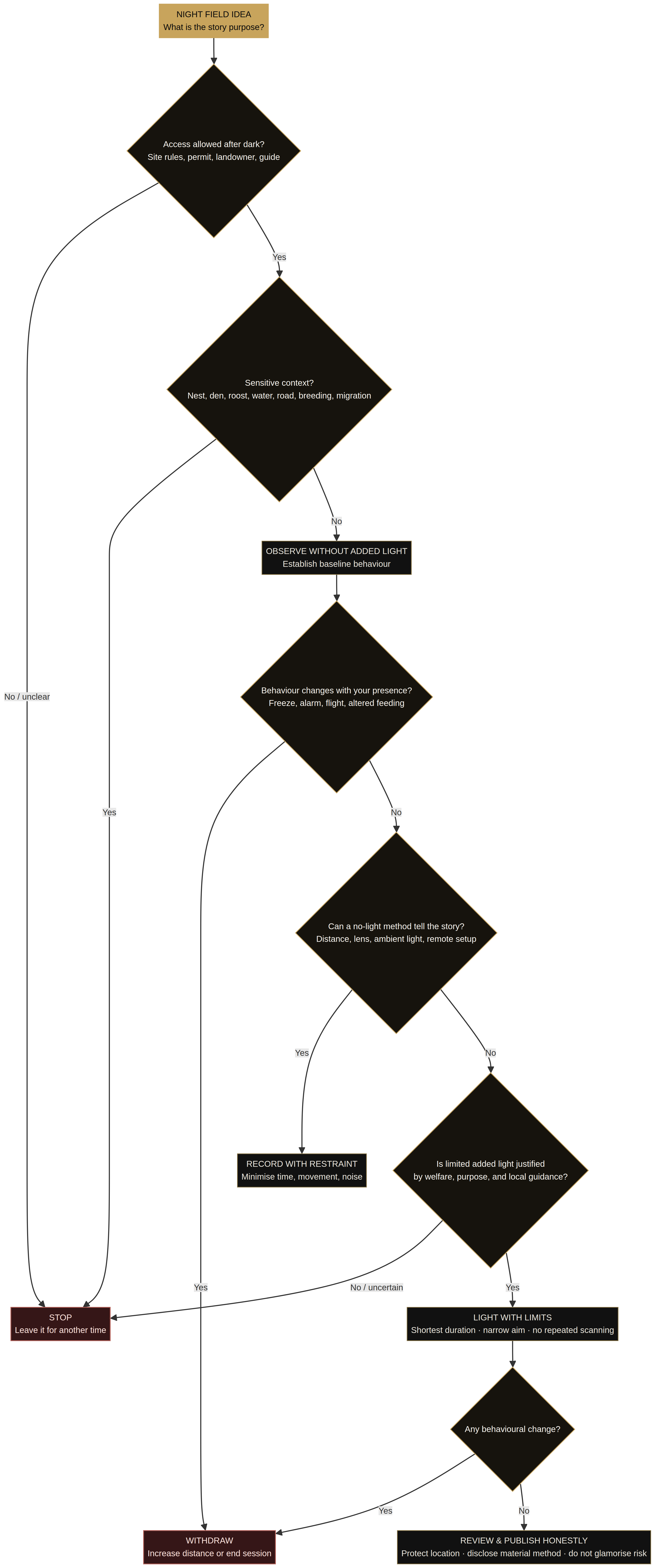
The decision pathway is a field aid. It does not replace local rules, permits, site knowledge, guidance from wardens or rangers, or a species-specific welfare assessment.
1. Night Is a Habitat, Not a Backdrop
Direct answer Darkness is not a neutral technical problem to be solved for a better exposure. Nighttime is an environmental condition that structures animal behaviour, physiology, and ecological interactions. The loss or alteration of natural darkness can shift foraging, navigation, reproduction, predator and prey activity, and sleep cycles. That is why treating darkness simply as a backdrop, or assuming that any flash or torch is an isolated technical tool, risks prioritising image quality over animal welfare.
Central welfare-first decision standard Every lighting decision at night must be guided by a single, simple welfare-first rule: choose the course of action that minimizes detectable harm to the animal and the greater site ecology, even if it reduces or prevents the picture you wanted. That rule sits on three practical commitments you can apply in the field:
- Minimize disturbance. If your presence, movement, or light changes the subject's behaviour in a way that could reduce survival, reproduction, or wellbeing, stop or back away [4][1].
- Prefer non-invasive alternatives. Use longer lenses, greater distance, remote camera setups, and timing strategies before resorting to additional light [1][5].
- Be transparent and accountable. If you would not be comfortable describing how a photograph was made because it involved actions you could not justify to a local manager, researcher, or the public, do not do it [4][5].
What this section and the guide do and do not claim This guide translates high-level research and ethical principles into a welfare-first decision framework for photographers working at night. It synthesises broad findings about artificial light at night and situates them beside practical photographer tactics and practitioner reflections. It does not claim to provide species-specific rules, fixed exposure settings, legal advice, or health thresholds for animal eyes or physiology. Peer-reviewed research addresses repeated or sustained artificial lighting and its ecological consequences, not every single photographic event. Nonetheless, repeated short events at the same site can approximate sustained exposure and warrant the same caution [2][3].
What the evidence and professional guidance support
- Broad evidence indicates that artificial light at night alters biological clocks, orientation, foraging, and ecological interactions across many taxa. These are system-level findings that justify a precautionary field principle about repeated or poorly directed light, and about planning work to avoid unnecessary illumination [2][3].
- Conservation and practitioner guidance emphasises minimising behavioural disruption, keeping distance, avoiding flash on sensitive nocturnal subjects when advised by specialists, and favouring methods that reduce human proximity to animals [1][4][5].
- Practitioner reflections remind photographers to read animals and respond, to use remote set-back camera systems where appropriate, and to be prepared to abandon a shot when an animal shows signs of stress or altered behaviour [5][6].
Field-use translation: how to think in the moment The point of a welfare-first standard is operational clarity. Below are concrete, evidence-aligned ways to apply that standard without overclaiming scientific certainty.
Before you light anything
- Know the site context. Research whether the location hosts light-sensitive activities such as migration staging, breeding, or roosting. Where possible, consult local managers, researchers, or published site guidance [4][2].
- Choose distance and optics first. Use lenses and set-up choices that let you avoid close proximity and excessive additional light [1][5].
- Plan a fallback: if the subject shows avoidance, altered vigilance, aborted feeding, or other atypical behaviour, stop photographing and withdraw.
In the field: observe, judge, and act
- Read baseline behaviour. Spend non-photographic time watching how animals behave in the dark before introducing light. This gives you a comparator for the animal’s natural rhythm.
- Introduce light slowly and sparingly. Use the minimum angle, intensity, and duration needed for safety and documentation, and always prioritise the animal’s response over the image.
- Stop if behaviour changes. If your light causes freezing, flight, cessation of feeding, repeated alarm calls, or approaches to or avoidance of a nest or shelter, reduce or remove the light and give the subject space [1][6].
A compact field triage table Use behaviour as your primary indicator. This table is a practical, conservative shortcut for in-the-moment decisions. It is based on welfare-first principles and practitioner heuristics, not on a claim that a single flash or torch has a universal physiological effect.
| Observed reaction within 30-60 seconds of introducing light | Field action (welfare priority) |
|---|---|
| No obvious change in behaviour; subject continues normal activity | Continue with caution. Keep lighting minimal and time-limited. |
| Heightened vigilance, repeated head or ear movements, or altered gait | Immediately reduce intensity and angle. If changes persist, stop and withdraw. |
| Flight, abandonment of a location, or refusal to return to a nest or roost | Cease photography and retreat. Reevaluate whether any further lighting at this site is justified. |
| Repeated approaches toward or avoidance away from an illuminated area | Remove the light and increase distance. Consider ending the session at this site. |
Notes on the table
- The time window is a practical observational guide, not a scientific threshold. Use your judgement; some species show delayed or subtle responses.
- The table is intended for single-session decisions. Repeated brief disruptions at a single place can accumulate into sustained impacts, which the broader literature addresses [2][3].
Remote setups, camera traps, and one-person techniques Remote and set-back cameras can reduce human proximity and the chance of direct disturbance, but distance alone is not a welfare guarantee [5][1]. Remote light sources, the frequency of triggered illumination, and the cumulative pattern of exposure matter. Audubon cautions against direct flash on nocturnal birds and recommends filtered infrared as an alternative in particular bird-photography contexts, while acknowledging that such alternatives do not universally eliminate risk [1]. Use remote methods only when they demonstrably reduce disturbance and when you can control how often and how intensely the subject is illuminated.
Spectrum, directionality, and duration: what research supports Reviews and conservation organisations encourage restricting illumination to essential places and times, directing light carefully, and considering spectral choices as part of mitigation planning [3][2]. Translating that into photography means:
- Limit duration. Keep each lighting event short.
- Directionality matters. Shield and aim light so it illuminates only the target area and not surrounding habitat.
- Consider spectrum. Where guidance is available for a particular species or site, prefer spectra that local managers or experts recommend. Remember that research on spectrum is about longer-term exposures; it cannot be used to guarantee safety for every short photographic event [3].
Practitioner heuristics you can adopt Practitioners who work at night provide useful, experience-based heuristics. Treat these as professional perspectives, not scientific consensus.
- Transparency heuristic. If you would not be comfortable explaining how you made an image to a site manager, researcher, or the public, do not use that lighting approach [5].
- Read-and-respond. Adjust or stop based on the animal’s immediate reaction; proactive reading prevents many avoidable impacts [6].
- Remote distance reduces some risks but not all. Remote triggers and set-back hides can lower human presence, but they may still produce repeated light exposure that can be problematic if left unchecked [5].
Community uncertainty and common questions Photographers and naturalists often ask how bright is too bright, whether flash harms insect eyes, or if one flash will affect a bat or moth. These questions are frequent and legitimate. Community forums show uncertainty about trade-offs between image quality and potential disturbance [7]. The research does not answer all such questions with simple numeric rules. Use the welfare-first decision standard and the behavioural triage table above rather than assuming a single event is harmless.
When research about sustained artificial light is relevant to photographers Peer-reviewed work on artificial light at night typically addresses repeated or persistent illumination and ecosystem-level changes [2][3]. This does not mean you must avoid every single night photograph, but it does mean you must be particularly cautious where:
- You will be photographing repeatedly at the same site.
- Your light use could emulate continuous exposure for the animal.
- The site is known for light-sensitive behaviours, such as breeding, migration staging, or communal roosting.
Further reading and practical links For deeper discussions that intersect with the welfare-first decision standard, see these journal entries: /journal/ethical-wildlife-photography-animal-welfare-sensitive-locations /journal/camera-trap-ethics-welfare-human-bycatch /journal/wildlife-sound-design-ethics-recording-playback-foley /journal/short-form-wildlife-video-conservation-literacy-responsible-reels /journal/honest-wildlife-post-production-documentary-integrity-licensing-prints
Final practical reminders
- Welfare first means sometimes walking away. The ethical choice at night often looks like a missed photograph.
- Prioritise behavioural observation over technical curiosity. You can always return another night with different plans or after consulting local experts.
- Keep records and be transparent in captions and project notes about methods used and reasons for stopping a shoot. Accountability builds better practice for the whole community [4][5].
This section establishes the working ethic for the rest of the guide. Use behaviour as your primary metric, adopt the welfare-first rule, and treat repeated or sustained lighting as qualitatively different from an isolated incidental flash. Where research speaks to long-term and repeated light exposures, apply those mitigation principles conservatively. Where practitioner experience raises cautionary points, adopt the suggested heuristics but do not treat them as scientific proof.
2. What the Evidence on Artificial Light at Night Can, and Cannot, Tell a Photographer
Begin with the evidence boundary. Much of the scientific literature and policy discussion addresses artificial light at night (ALAN) as a persistent, landscape-scale or repeatedly applied influence. These studies document shifts in timing, behaviour, reproduction, navigation, predator-prey relationships, and ecosystem processes when night-time darkness is reduced over time or across whole habitats [2, 3]. That body of work supports a clear precautionary mindset for repeated, sustained, or poorly directed lighting. It does not, however, provide a simple, universal prescription for every single photographic flash, torch beam, or infrared trigger.
What the sustained-ALAN research reliably supports
- Repeated or chronic illumination should be minimised in places and at times when wildlife depends on darkness. DarkSky International and reviews of ALAN effects identify broad risks across many taxa and habitats, and recommend reducing unnecessary illumination, directing light carefully, and restricting timing and location of light exposure [2, 3].
- Mitigation principles from the literature are operational: use light only where and when necessary; avoid broadly scattering light; and consider spectral properties when planning long-term installations or repeated field work. These are planning rules, not quick technical rules for a single exposure [3].
What the research does not give you
- There is no single scientific threshold (intensity, duration, distance) that translates cleanly from landscape-level studies to every photographic situation. Reviews and syntheses emphasise context dependence rather than one-size-fits-all numbers [3].
- Large-scale research does not directly quantify the risk of a one-off, brief flash or infrared pulse for every species and situation. Evidence for acute effects from a single photographic event is limited or absent in the referenced literature, so you must avoid assuming safety where specific data are not available.
Practitioner experience and public uncertainty
- Seasoned field photographers and conservation practitioners offer useful operational heuristics. Greg Basco separates unverified physiological claims from legitimate welfare concerns and suggests the transparency heuristic: if you would not feel comfortable explaining how an image was made to colleagues or the public, reconsider the method. He also notes remote, set-back cameras can reduce human proximity but distance alone is not a welfare guarantee [5].
- Doug Gimesy frames the question as primarily behavioural: read the subject and respond. He emphasises that additional lighting should be a welfare decision first, photographic ambition second [6].
- Community forums show ongoing uncertainty about macro work and flashes on insects and moths. These discussions are useful to gauge common field questions but are not scientific evidence [7].
Putting the different kinds of evidence together
- Use the sustained-ALAN literature to inform policies and site-level planning. If you will be working repeatedly in a location, or your lighting will be present for long periods, treat it like a lighting installation: minimise, direct, restrict, and avoid cumulative exposure for resident animals [2, 3].
- Treat single photographic events as situations in which we lack universal answers. Apply conservative, welfare-first decision rules informed by practitioner experience and the known risks of sustained light. Avoid extrapolating safety from absence of evidence.
A compact decision matrix for on-the-spot choices
| Question to ask | Evidence base | Practical action |
|---|---|---|
| Is lighting repeated at this site (daily or nightly) or likely to be used again soon? | Strong evidence that repeated exposure alters behaviour/ecosystems [2, 3] | Avoid establishing repeated lighting. Use non-invasive alternatives; seek permission and local guidance. |
| Is the subject in a sensitive context (breeding, roosting, fledging, dense aggregation)? | Sustained disturbance is known to harm sensitive life stages; situational sensitivity is inferred by policy/practice [2, 3, 1] | Do not use additional light; back away and observe from distance. |
| Is the animal displaying stress or behavioural change (freeze, flush, stop feeding)? | Behavioural responses are the immediate welfare signals; practitioners emphasise reading the subject [5, 6] | Stop lighting immediately and retreat. |
| Is flash or torch necessary for documentation (e.g., for safety or to prevent misidentification)? | Limited direct evidence for single-exposure harm; precaution still advised [3] | If necessary, use minimal, indirect, and infrequent light; prioritise alternatives. |
| Are there site rules or species protections in place? | Ethics guides and management bodies require compliance and transparency [1, 4] | Follow local rules; remove location metadata for sensitive species when required [1]. |
Field-level practices that respect the evidence limits
- Prioritise alternatives. Use long lenses, remote triggers, longer exposures where possible, and conceal proximity rather than increasing light exposure. Audubon explicitly stresses distance and non-invasive approaches and advises sparing use of flash, particularly with nocturnal birds [1].
- If you decide light is essential, minimise and test. Limit the number of flashes, reduce frequency of visits, avoid repeated nightly illumination at the same location, and observe for immediate behavioural responses. These operational choices are consistent with ALAN mitigation principles on reducing exposure and directing light carefully [3].
- Avoid direct beams into the eyes or faces of animals if you can. Practitioner advice repeatedly frames human responsibility to reduce direct disturbance, and observers should provide an escape route and allow animals to resume normal behaviour [5, 6].
- Be particularly conservative in known high-sensitivity contexts such as breeding colonies, roost sites, wetlands, and migration stopovers. These are the contexts where sustained lighting is already known to produce population-level effects [2, 3].
- Record and be transparent. Document methods, time, number of exposures, distance and context so that editors, peers, and managers can assess welfare considerations. U.S. Fish and Wildlife Service guidance highlights minimising negative impacts and being transparent in capture and publication practices [4]. Basco’s transparency heuristic is a practical check before publishing images made with artificial illumination [5].
A short operational checklist before you raise a light
- Have I read the subject and the site? Is the animal calm and unconstrained?
- Is this a one-time necessity or will similar lighting occur repeatedly here?
- Are there known local restrictions, nest sites, or vulnerable life stages present?
- Can an alternative technique achieve the image with less risk?
- Will I stop immediately if I see behavioural change, and will I report or document what I did?
When practitioner guidance fills the gap Practitioners offer the most direct, experience-based guidance where formal science is sparse. Use these as heuristics, not as definitive science. Greg Basco’s emphasis on transparency, and Doug Gimesy’s emphasis on reading the subject, should be treated as field-tested guidance to reduce harm when empirical data are absent [5, 6]. Community threads, such as those on iNaturalist, are useful for understanding common doubts and emerging questions, but they are not a substitute for research or local regulations [7].
Links to other useful, related guidance
- For guidance on sensitive locations and animal welfare considerations, see /journal/ethical-wildlife-photography-animal-welfare-sensitive-locations
- For considerations specific to camera traps and the risk of human bycatch, see /journal/camera-trap-ethics-welfare-human-bycatch
- For parallels in auditory disturbance and playback ethics, see /journal/wildlife-sound-design-ethics-recording-playback-foley
- For short-form video and repeat exposure considerations, see /journal/short-form-wildlife-video-conservation-literacy-responsible-reels
- For post-production transparency and disclosure expectations, see /journal/honest-wildlife-post-production-documentary-integrity-licensing-prints
Final caution Do not treat the absence of a universal threshold as permission to guess. Where direct evidence for single-event effects is limited, default to the precautionary principle informed by sustained-ALAN literature, practitioner experience, and immediate behavioural cues from the animal [2, 3, 5, 6]. Welfare before image quality must guide your choices, and accountability and transparency should follow every decision you make in the field [1, 4].
This guidance is practical and research-led, but not legally binding. Always check local regulations and site-specific restrictions before any nocturnal work.
3. Before You Go: Purpose, Permission, and the Right to Say No
Make the pre-field decision with the welfare of the animal and the integrity of the place as the first filter. Ethical commitments shape what you pack, who you work with, and whether you go at all. The U.S. Fish and Wildlife Service ethical framework,minimize negative physical, emotional, and behavioural impacts; be transparent; respect laws and customs,provides a useful rubric for decisions, without substituting for local consultation or permitting processes [4].
Clarify your purpose Be explicit about why you are doing a night shoot. Different purposes require different tolerances for risk and intrusion.
- Scientific or management work will often require formal permits, a clear experimental protocol, and reporting to managers.
- Editorial or story work should be upfront about methods and must avoid staged or baited scenes presented as natural.
- Practice, testing gear, or portfolio building offer the least ethical justification for any activity that risks repeated disturbance.
Audubon’s guidance for bird photography is a helpful reminder: welfare and habitat come before photographic ambition, and flash should be used sparingly, if at all, especially on nocturnal species that may rely on undisturbed dark periods for hunting and navigation [1]. Greg Basco’s practitioner reflection adds a practical test: if you would not feel comfortable explaining exactly how the image was made to a researcher or manager, reconsider the method [5].
Permissions, protected-area conditions, and night-access rules Do not assume rules are permissive or uniform. Many protected areas, wildlife refuges, and private reserves have explicit night closures or require specific permits for after-dark access. Some managers allow nighttime access only for approved research or guided programs; others prohibit artificial lighting entirely.
Practical steps before travel or entry
- Contact the land manager well in advance. Ask whether night access is allowed, whether photography requires a permit, and whether there are rules about lighting, flash, tripods, hides, or remote sensors.
- Ask for written or electronic confirmation of any permit or written permission you receive.
- If working in community lands or on privately owned property, obtain explicit owner consent and confirm boundaries, hours, and any special conditions.
- Confirm whether you will need to report observations, provide copies of images, or follow specific data-handling rules for sensitive species.
Do not interpret a verbal “okay” from a third party as permission from the controlling authority. Never assume rules in one jurisdiction transfer to another.
Working with local guides and communities Local guides and community partners are both safety and welfare assets. They can advise on species-specific sensitivity, customary access, local regulations, and situational risks that are not obvious from a map or permit form. Hiring a qualified local guide can reduce human proximity required to obtain images and improve biosecurity and cultural respect.
However, the presence of a guide does not remove your ethical obligations. If a guide suggests a method you are uncomfortable with, you retain the right and responsibility to refuse. Clarify roles and decision-making before arrival: who is responsible for welfare judgments in the field, and who will stop work if an animal shows signs of disturbance.
Private land and written permissions On private property, secure and keep a copy of written permission. Clarify:
- exact hours you are allowed on site;
- whether night access is covered;
- limitations on lighting or equipment;
- expectations about leaving GPS or location metadata in published images;
- whether you may bring assistants, vehicles, or other people.
Audubon also recommends removing exact GPS data for rare or sensitive species when publishing images [1]. This is a precaution that applies wherever revealing precise locations could elevate the risk to animals.
Risk assessment before the first shutter Before you leave for the field, perform a concise risk assessment focused first on welfare and safety, then on legal and reputational risk. Consider these questions:
- Do I have explicit permission to be on site at night?
- Is the species or habitat known to be sensitive to light or human presence?
- Will my lighting be a single brief event, or could it become repeated or sustained?
- Can I retreat quickly if the subject shows disturbance?
- Do I have contingency plans for equipment failure and for situations that could force prolonged illumination?
- Do I and my team understand how to recognise behavioural disturbance and stress?
Distinguish sustained artificial light at night from individual photographic events. The literature on artificial light at night documents broad ecological risks from repeated, sustained, or poorly directed illumination that alters natural dark periods and affects behaviour, reproduction, navigation, and ecological interactions [2][3]. These findings reinforce a precautionary approach to repeated or long-duration light use in the field, but they do not mean every single flash or short-duration light equals those sustained exposures. Use the distinction to avoid normalizing repeated light use in sensitive places.
A compact pre-field decision table
| Condition to check | Proceed with caution | Postpone or cancel |
|---|---|---|
| You have written permission or permit for night access | Yes, and confirm lighting conditions with manager | No, do not proceed |
| Night access allowed but lighting is explicitly restricted | Use minimal, directed, and temporary light; have mitigation plan | If restriction prohibits your methods, postpone |
| Subject or habitat known to be sensitive to light or repeated disturbance | Reduce exposure, use remote set-back methods, limit sessions | If you cannot avoid repeated or sustained lighting, cancel |
| Your method risks prolonged illumination (equipment failure, baiting, long waits) | Rework plan to avoid prolonged light | Cancel or redesign |
| Local guide or community advises against activity | Reassess; follow local expertise if safety/welfare risk confirmed | Cancel if concerns persist and cannot be mitigated |
Mitigation measures to consider in planning
- Prefer remote, set-back cameras and triggers to reduce repeated human proximity and disturbance. Practitioners have used remote setups to lower the need for close human presence, but distance alone is not a welfare guarantee [5].
- Reduce the likelihood of prolonged illumination by carrying redundant batteries, protective covers, and an agreed procedure for shutting down setup quickly if something goes wrong.
- Design sessions to be brief and to avoid repeated light use on the same individuals or roosts. Repeated short events can add up.
- Use directional, low-intensity lighting only where managers allow, and avoid leaving lights on unattended.
- Plan for non-visual methods where appropriate. See related discussions on camera-trap ethics and audio work: /journal/camera-trap-ethics-welfare-human-bycatch, /journal/wildlife-sound-design-ethics-recording-playback-foley.
Practitioner perspectives on reading the subject Practitioners emphasise careful observation and the right to stop. Doug Gimesy frames additional lighting as a welfare question to be answered by watching the subject and responding if it shows signs of disruption [6]. Greg Basco stresses being able to explain and justify methods, and he reports using remote setups to reduce close human presence [5]. These are experience-based perspectives and do not replace species-specific studies, but they are useful operational guides: read the animal, document signs of disturbance, and stop if you are unsure.
Community uncertainty and public questions Public and practitioner communities frequently ask whether flash and bright torches harm nocturnal insects or other invertebrates. The iNaturalist community thread shows these are common uncertainties among readers, not settled scientific conclusions [7]. Use such discussions as indicators where more careful planning and restraint may be warranted, especially with taxa for which there is limited published guidance.
When to cancel ethically Cancellation is an ethical action, not a failure. You should cancel or leave if any of these conditions obtain:
- You lack the required permit or written landowner consent.
- Local managers, community leaders, or a qualified guide advise against the activity for welfare or cultural reasons.
- Weather or site conditions increase the chance of prolonged lighting, entrapment, or inability to retreat.
- The subject demonstrates signs of disturbance after initial approaches or short test exposures.
- Equipment failure will force longer illumination or repeated attempts that could cumulatively harm animals.
- You are not prepared to be transparent about methods, for instance when editors or managers would demand a full account you cannot ethically provide.
If you cancel, document the reason, notify local managers or guides if appropriate, and review the plan so you do not repeat the same error. Ethical cancellation preserves trust with managers, protects animals, and maintains your credibility.
A final field ethic The pre-field decision is not a once-only step. Commit to stopping early if the situation changes. Priorities in order: animal welfare first, legal and community expectations second, image quality last. Where scientific studies of sustained artificial light provide general mitigation principles, such as restricting illumination to essential times and places and directing light carefully, apply those principles conservatively to night shooting and never as a substitute for local rules and direct observation of the animal in front of you [2][3].
For methods that may overlap with other disciplines, consult the related guidance on camera traps, audio work, and post-production ethics: /journal/camera-trap-ethics-welfare-human-bycatch, /journal/wildlife-sound-design-ethics-recording-playback-foley, /journal/short-form-wildlife-video-conservation-literacy-responsible-reels, /journal/honest-wildlife-post-production-documentary-integrity-licensing-prints, and /journal/ethical-wildlife-photography-animal-welfare-sensitive-locations.
If in doubt, say no. Saying no protects animals, preserves access for others, and keeps ethical practice at the centre of night-time wildlife photography.
4. Reading the Subject Before You Touch the Light
Night-time ethical practice begins with knowing when to shoot and when to desist. Before you bring a torch, flash, or IR source close to an animal, you must first learn what “normal” looks like in that place and moment, and then watch for clear signs that your presence or lighting has altered it. This section presents a practical observation and withdrawal framework you can use in the field. It rests on the ethical principles of minimizing harm and accountability from the U.S. Fish and Wildlife Service [4], and on broader evidence that sustained or repeated artificial light at night can alter behaviour, reproduction, navigation, and ecological interactions [2][3]. It also incorporates practitioner reflections about reading subjects and reducing proximity [5][6] and acknowledges recurring field questions about insect flash use from community discussion [7].
Make a clear distinction in your planning
- Research on artificial light at night (ALAN) addresses repeated, prolonged, or poorly directed lighting and its cumulative ecological effects. Those findings justify a precautionary approach in the field, but they do not translate into a single universal flash setting or a claim about outcomes from every individual photographic event [2][3].
- Your immediate duty is to observe and interpret behaviour conservatively. If a single use of light might temporarily interrupt feeding, flight, roosting, or nesting, you should treat that as an ethical cost and prioritize welfare over image quality [1][4].
Pre-approach checklist
- Know the site rules and sensitivities. Location guidance and limits on time at nests or sensitive areas are basic practice for ethical photographers [1][4].
- Do homework on general natural history and known sensitive times. Use that knowledge only to shape a conservative baseline, not to assume a predictable response.
- Prepare to be transparent about your method. Practitioners advise that if you would not be comfortable explaining how an image was made, you should reconsider the method [5].
Establishing baseline behaviour
- Arrive quietly and take time to observe without any artificial light. Your goal is to learn the subject’s current routine: foraging patterns, use of perches or routes, vocal behaviour, timing of movements, and any nearby nests, dens, roosts, or movement corridors.
- Allow the animal uninterrupted time to display normal behaviours. For some subjects this will be brief; for others it can require longer observation. The key is that you identify a clear baseline before introducing any light.
- Record or note simple baseline markers you can re-check after introducing light: is feeding continuous, are adults attending young, is breathing or panting noticeably different, is the animal relaxed or tense, are movements fluid or hesitant.
Recognizing alert postures and disturbance cues Look for immediate, observable signals that your presence or use of light is changing behaviour. Typical cues across taxa include:
- Head-turning, repeated scanning, or sustained freezing.
- Sudden cessation of feeding or caregiving, or visible reluctance to continue approaching a nest or den.
- Flushing or sudden escape responses where no predator is obvious.
- Repeated direction changes when moving through a corridor that previously had a steady route.
- Vocal alarm calls or agitated calling where quiet had been the baseline.
Audubon guidance for birds emphasizes backing away if a subject flushes or changes behaviour and using flash sparingly, especially around nocturnal birds [1]. Practitioners have warned that repeated light near nests or roosts can change parental attendance and feeding decisions; these practitioner observations should be treated as reasons for caution rather than definitive physiological claims [5][6].
A compact decision table for immediate field use
| Observed cue | Immediate action | Rationale |
|---|---|---|
| No detectable change from baseline after unobtrusive light introduction | Proceed with conservative lighting and continuous monitoring | You still carry the burden to stop if change appears |
| Alert posture or scanning | Stop using the light and withdraw quietly to previous position | Early sign of disturbance; avoid escalation |
| Cessation of feeding or caregiving | Abort the set, remove light, and retreat completely | High welfare risk for dependent young |
| Repeated route deviation or hesitation in movement corridor | Cease lighting; relocate or abandon session | Disruption of movement can increase predation risk or energy costs |
| Flushing, escape, or clear flight/flighty behaviour | Immediate retreat and no further light use | Strong evidence of acute disturbance |
Introduce light only incrementally
- If you decide to use light, introduce it in the smallest, short-duration increments you can make while keeping the subject’s welfare as the primary criterion.
- Watch for any immediate shift from baseline. If any of the cues in the table appear, stop and withdraw.
- Remember that absence of an immediate reaction does not guarantee absence of longer-term impact. Repeated short uses across multiple nights can have cumulative effects similar to sustained lighting, which is why planning and minimizing repeat disturbance matter [2][3].
Nesting, roosts, dens, and movement corridors demand extreme care
- Nests, dens, roosts, and habitual movement corridors are hotspots of sensitivity. Disturbance here can have disproportionate consequences because animals may abandon sites, reduce provisioning rates, or alter routes to avoid perceived risk.
- Audubon explicitly advises limiting time at nests, avoiding baiting, and following local rules; similar caution applies at roosts and dens [1].
- If you encounter animals actively provisioning young or tightly confined in a roost, the default decision should be to withdraw rather than to attempt to light and capture an image.
Remote and indirect lighting approaches: practitioner notes and limits
- Remote, set-back camera and trigger setups can reduce human proximity and have been advocated by experienced photographers as a way to lower visible human disturbance [5]. Use the /journal/camera-trap-ethics-welfare-human-bycatch guidance when planning such setups.
- However, distance alone is not a welfare guarantee. Remote flash or other remote illumination still introduces light to the animal’s space and can cause behavioral change. Audubon cautions against direct flash for some nocturnal birds and notes that alternatives such as filtered infrared have been used in specific bird contexts, without establishing universal safety [1].
- Practitioners stress reading the subject and responding rather than relying solely on equipment changes [6].
Macro and invertebrate considerations
- Community discussion shows recurring uncertainty about flash and flashlights for nocturnal insects such as moths [7]. That uncertainty is a signal to err on the side of restraint.
- In macro situations, where small animals are close to the light source, even low-intensity illumination can feel intense to the subject. Reduce intensity, shorten durations, and use shielding to keep light directional and limited.
Distinguish single events from sustained exposure
- Research on ALAN warns of the ecological consequences of ongoing, poorly directed lighting [2][3]. While single, carefully managed photographic events are not the same as chronic urban lighting or industrial installations, repeated sessions, long-duration exposure, or leaving lights on unattended can approximate sustained exposure in their effects.
- When planning multiple visits to a site, factor potential cumulative effects into your decision. A sequence of short disturbances across several nights is not ethically equivalent to a single well-considered event.
A practical, conservative workflow you can follow
- Observe baseline: do not use light for an initial period; record behaviour.
- Introduce minimal light: low intensity, brief pulses, directional and shielded.
- Monitor continuously: watch the baseline markers you recorded.
- Respond immediately: if any disturbance cue appears, stop, remove light, and retreat.
- Debrief and document: record conditions, your actions, and why you stopped if you did. Transparency about methods is an ethical obligation [4][5].
When to walk away
- If the subject is using the space for feeding young, appears to be habituated only in the absence of light, or you cannot reliably re-establish baseline after introducing light, abandon the attempt.
- If you feel any moral discomfort about the technique you are planning, that discomfort is a valid signal to choose a less intrusive approach [5].
Related reading and tools
- For planning remote setups and thinking about human-bycatch in camera traps, see /journal/camera-trap-ethics-welfare-human-bycatch.
- For considerations about sensitive locations and general animal-welfare guidance, see /journal/ethical-wildlife-photography-animal-welfare-sensitive-locations.
- If your work involves combining light with playbacks or sound, consult /journal/wildlife-sound-design-ethics-recording-playback-foley.
- For honesty in post-production and accurate captions that reflect any behavioural trade-offs made, consult /journal/honest-wildlife-post-production-documentary-integrity-licensing-prints.
Final ethical reminder Your first responsibility in every night-time session is to the animals and ecosystems you are photographing, not to the shot. The precautionary principles drawn from ALAN research argue for restricting illumination to essential places and times, keeping light directed and minimal, and considering cumulative exposure when you plan repeat visits [2][3]. Follow established wildlife photography ethics about minimizing disturbance, being transparent about methods, and erring on the side of withdrawal when in doubt [1][4]. Practitioners reinforce that careful observation and willingness to stop are the core skills of responsible night-time photography [5][6], and community uncertainty around some techniques underscores the need for humility and restraint [7].
5. Flash: A Tool With a Narrow Ethical Window
Flash is a bright, concentrated intervention into an animal’s night. It can produce technically excellent images, but it also carries welfare and ecological questions that are different from daytime choices. Start every decision with welfare before image quality, and treat artificial light at night as a potential disturbance rather than a neutral tool.
Sustained light-at-night research versus individual photographic flashes
- Decades of research on artificial light at night (ALAN) document that ongoing, poorly directed, or widespread illumination can alter behavior, reproduction, navigation, sleep, and community interactions across taxa [2][3]. Those studies address sustained or repeated exposures at landscape or nightly scales, not single photographic events.
- That distinction matters. You cannot assume a single flash is equivalent to chronic lighting, but the principles from ALAN research support a precautionary approach: restrict illumination to essential places and times, direct light carefully, and consider spectrum and duration when planning work [3][2].
- Apply those mitigation principles to field practice. When in doubt, default to minimizing illumination and exposure frequency rather than seeking a one-shot technical solution.
Hard limits and contexts to avoid flash
- Nocturnal birds: Guidance from experienced bird-welfare authorities advises against flash on nocturnal birds such as owls and nightjars at night because flashes may temporarily limit hunting or obstacle avoidance and can disrupt normal behaviour [1]. For nesting birds, avoid any lighting that provokes adult abandonment, altered feeding patterns, or stress responses; nest sites deserve particular restraint [1].
- Nests and young: Independent ethics frameworks place minimizing physical and behavioural impacts at the top of obligations to subjects. Stay away from repeated bright-light events at nests, and cut any session where adults alter attendance or feeding behaviour [4][1].
- Gliding or landing species: Practitioners caution that abrupt illumination can create flight or landing risks for species that rely on low-light cues. Treat gliding mammals, low-flight birds, and species that navigate by dim visual cues with extra caution, and avoid flash if it could interfere with movement [6].
Direct flash versus remote or filtered illumination
- Direct, on-body flash aimed at a subject has higher immediate potential to startle, disorient, or momentarily impede behaviour. Audubon explicitly warns against direct flash near some nocturnal birds and flags filtered infrared as an alternative for remotely triggered set-ups in specific bird-photography contexts; that is a context-specific suggestion, not a universal safety endorsement [1].
- Remote set-ups and triggered cameras reduce human proximity, which can reduce some forms of disturbance, but physical distance alone does not guarantee welfare. Remote flash still delivers a light pulse to the animal and may carry the same behavioural consequences as an on-camera flash [5].
- Infrared or longer-wavelength lighting can be useful in a remote camera context, but their safety and perceptibility vary by species and equipment. Do not assume infrared is harmless for all taxa or all behavioural contexts. Audubon’s advice about filtered infrared applies within a particular bird-photography context and should not be generalized without verification [1].
Frequency, repetition, and cumulative exposure
- Research on ALAN emphasizes cumulative and sustained exposure as the central risk factor for ecological and physiological disruption [2][3]. While single photographic flashes are brief, repeated bursts over nights or many individuals can create an exposure regime with potential consequences.
- Apply a conservative rule: minimize the number of flashes and the number of nights of exposure. If a subject tolerates one low-impact event, consider that a limit, not a green light to repeat. Repeated exposures near nests or roosts are especially problematic because they can accumulate into meaningful disturbance even if single events appear benign.
- Practitioners recommend planning for a single frame or a brief sequence only and ceasing use if any behavioural change is observed [5][6].
Reading the subject and stopping thresholds
- Use behaviour as the primary welfare indicator. Stop immediately if the animal:
- freezes in a posture that suggests disorientation,
- ceases feeding or returns from feeding trips less frequently,
- abandons a nest or den, or
- moves repeatedly away from the area.
- Field heuristics from experienced photographers emphasize that if you would not be comfortable explaining the method and its potential impacts to a collaborator or manager, do not proceed [5]. Transparency is both an ethical obligation and a field safeguard.
Transparency and accountability
- Record and report how images were made. The U.S. Fish and Wildlife Service ethics guidance stresses minimizing negative impacts and being accurate in captions and storytelling [4]. Be explicit about any use of flash, remote triggers, or infrared in captions and metadata where disclosure does not endanger a sensitive location.
- Practitioner guidance recommends the same transparency heuristic: if you cannot defend the method in public or to a stakeholder, choose another technique [5].
- For sensitive species and locations, follow accepted disclosure practices such as removing precise GPS tags where required by local guidance to reduce the risk of disturbance from publication. See /journal/ethical-wildlife-photography-animal-welfare-sensitive-locations for broader guidance on sensitive-location publication choices.
Practical decision table
| Situation | Use of flash recommended? | Primary concerns | Minimum safeguards if flash is considered |
|---|---|---|---|
| Nocturnal owls, nightjars, similar species | Generally avoid | Potential hunting disruption, obstacle avoidance, behavioural change [1] | Do not use direct flash; consider non-invasive observation, remote infrared only with species-specific verification [1] |
| Active nest or young present | Avoid | Adult abandonment, feeding reduction, increased predation risk [1][4] | Prefer no flash; if unavoidable, stop if behaviour changes and document methods [4] |
| Remote camera at a non-nesting perch | Conditional | Cumulative exposure, direct illumination effects [1][5] | Use remote triggers, minimize flash power and frequency, consider filtered infrared after verification; log exposures and effects [5] |
| Gliding/landing species or low-flight mammals | Avoid if possible | Disorientation during flight or landing [6] | Prefer ambient-light techniques; if used, test from a distance and stop on any flight-change behaviour [6] |
| Nocturnal insects and moths | Not resolved; community concern | Uncertainty about sensory impacts and cumulative effects [7] | Treat as precautionary: minimize brightness and repetition; consult local experts [7] |
Field checklist before firing any flash
- Ask whether the image requires flash for welfare-safe documentation. If not, use available low-light techniques or wait.
- Know the site rules and any species-specific recommendations. Follow broader ethical principles about minimizing harm [4][1].
- Plan for a single exposure. Prefer single-frame capture over bursts and avoid multiple nights of repeated lighting at the same site.
- Use the lowest practical flash power, and avoid direct on-axis illumination if possible. Consider off-camera, diffused, or shielded light only where it demonstrably reduces disturbance.
- Watch the subject continuously and stop immediately on signs of behavioural change.
- Log method details and exposures for later review and reporting. Be transparent in captions and accompanying notes about how the image was made [4][5].
Practitioner perspectives (attributed)
- Some wildlife photographers highlight remote, set-back camera and trigger setups as a way to reduce human proximity while still documenting nocturnal species; these techniques can reduce trampling and human presence but do not eliminate the light pulse the animal receives. Distance helps, but it is not a welfare guarantee [5].
- Other experienced photographers frame additional lighting as a welfare question that should be answered by carefully reading the subject and responding by stopping if disturbance occurs. They also emphasize species- and context-specific sensitivity, for example, the extra risk for gliding mammals and low-flight animals [6].
Community questions and unresolved areas
- Community forums show recurring uncertainty about flash and nocturnal insects, macro work, and whether image quality justifies potential disturbance [7]. These are legitimate questions for practitioners to bring to local experts and researchers before routine use. Community discussion is useful for surfacing uncertainties but does not replace empirical studies.
Anecdote (composite)
- A composite field recollection commonly shared among photographers: after several nights of trying to get an owl portrait, the photographer noticed fewer feeding flights and increased agitation around the roost. They stopped using flash, switched to longer lenses and patience-based observation, and eventually obtained natural-light images without further disturbance. Use stories like this only to illustrate the precautionary mindset; they are practitioner experience, not formal evidence.
Final guidance summary
- Treat flash as exceptional. Prioritize techniques that do not introduce bright, abrupt illumination into an animal’s night.
- When flash seems necessary, constrain it tightly: single low-power exposures, remote methods only with species verification, continuous behavioural monitoring, explicit documentation, and immediate cessation on any sign of disturbance.
- Remember that research on sustained ALAN argues for restricting illumination in time, place, and spectrum [3][2]. Those principles should guide how you translate a single-session decision into responsible practice.
- For detailed practices around sensitive locations, camera traps, sound use, and truthful reporting, consult these guides: /journal/ethical-wildlife-photography-animal-welfare-sensitive-locations, /journal/camera-trap-ethics-welfare-human-bycatch, /journal/wildlife-sound-design-ethics-recording-playback-foley, /journal/short-form-wildlife-video-conservation-literacy-responsible-reels, and /journal/honest-wildlife-post-production-documentary-integrity-licensing-prints.
Citations: Audubon guidance on flash and nocturnal birds [1]; ALAN and mitigation principles from DarkSky and Falchi et al. [2][3]; U.S. Fish and Wildlife Service ethics for transparency and minimizing impact [4]; practitioner perspectives attributed to Greg Basco and Doug Gimesy [5][6]; community questions on nocturnal insects from iNaturalist discussion [7].
6. Continuous Light, Spotlights, Headlamps, and the Cost of Staying On
When you point a continuous light source at wildlife you change more than the frame. Duration, direction, movement, glare, and the habit of repeated scanning each influence an animal's behaviour and, when repeated over time or across a landscape, can change ecological relationships. Long-term research on artificial light at night shows broad risks to foraging, orientation, reproduction, migration, and rhythms that animals use to time life history events [2] [3]. Those studies relate to sustained or repeated lighting regimes rather than single photographic acts. Still, the principles they establish about careful placement and minimal exposure translate directly to field behaviour for photographers and filmmakers.
Why these five properties matter
-
Duration. A light shone for seconds may be less disruptive than one left on for minutes or hours, but duration matters in non-linear ways. Repeated or prolonged illumination at the same site can cumulate into habitat-level change even if each individual exposure seems small. Research on artificial night light emphasizes restricting illumination to essential places and times as a mitigation principle [3] and cautions against treating every exposure as negligible simply because it is brief [2].
-
Direction. Where the beam travels matters. Light aimed toward an animal's eye, a nest, a den entrance, or a flight corridor is more likely to affect behaviour than light aimed at background vegetation. Directing spill onto non-sensitive surfaces reduces the chance of causing startle, distraction, or altered navigation.
-
Movement. Sweeping beams and rapid scanning are especially likely to provoke escape responses, to startle animals in flight, or to draw attention away from normal activities. Constant searchlight movement adds a predator-like dynamic: it changes perceived risk, can interrupt feeding or mating, and increases the chance of collision for flying animals.
-
Glare and contrast. High contrast between a lit subject and a dark background can make animals freeze, bolt, or misjudge distances. Glare also reduces the animal's ability to see its surroundings, potentially increasing collision risk for species that navigate by visual cues.
-
Repeated scanning. Returning repeatedly to the same tree, burrow, pond edge, or trail with bright light is not the same as a single event. Long-term light exposure can change predator-prey interactions and habitat use. Conservation-minded sources advise minimizing repeat disturbance and designing any necessary illumination with restraint [2] [3].
Exploratory light versus deliberate illumination
Make a practical distinction in your own workflow between two common uses of light.
-
Exploratory light. This is the brief, often low-level illumination used to locate a subject, check gear, or make an initial assessment of behaviour. Done properly it is short, predictable, and conservative.
-
Deliberate illumination. This is the sustained or purposefully directed light used to model, shape, or expose a scene for photography or video. It is brighter, held longer, and therefore more likely to alter behaviour if not carefully controlled.
The ethical starting rule is to keep exploratory lighting exploratory. Use it to confirm presence, distance, and whether the animal is behaving normally. If the subject seems unsettled at any point, stop. If you cannot get the image without sustained illumination that changes the animal's behaviour, the welfare-first choice is to accept a different composition or to withdraw.
Practitioner perspectives and heuristics
Experienced field photographers and conservation photographers frame this as both an ethical and a practical problem. Greg Basco emphasizes a transparency heuristic: if you would not feel comfortable explaining how an image was obtained to a collaborator or the public, reconsider the method [5]. He also reports using remote, set-back camera trigger setups as one way to reduce human proximity, while noting that distance alone is not a welfare guarantee. Doug Gimesy urges reading the subject and responding, treating additional lighting as a question answered by direct observation of impact rather than by assuming a technical workaround is always safe [6]. Both perspectives support a field ethic of observing, testing with extreme caution, and favouring the least intrusive option.
Practical restraint in the field
Below are practical choices that foreground welfare over exposure. They are not camera settings or recipes. They are behavioural decisions you can apply wherever you work.
-
Plan before switching on. Think through your approach while still in darkness. Know where you can stand so that your light will not fall directly into roosts, dens, nests, or flight corridors.
-
Test at low output. Use the minimum lumens or low output modes to make the initial assessment. The less you turn on at first, the lower the risk.
-
Use short bursts for checking. Brief flashes of light to confirm position are preferable to continuous illumination for locating subjects, provided you watch for signs of disturbance.
-
Keep beams low and angled away from eyes and flight paths. Aim lights toward the ground or non-sensitive surfaces when possible.
-
Stop if behaviour changes. If the animal freezes, flees, ceases feeding, stops vocalizing, or moves to concealment, immediately switch off the light and back away. That response alone is a valid measure of impact.
-
Avoid sweeping or jerky motion. Hold the beam steady and deliberate. Rapid scanning amplifies startle effects and resembles predatory search.
-
Limit repetitions at the site. If you need multiple passes, space them out in time and vary your approach to avoid habituation or chronic disturbance.
-
Be transparent in publication. Document how the image was obtained and disclose any use of continuous illumination or staged light in captions or accompanying text. This follows broader ethics guidance on transparency and minimizing negative impacts [4] and aligns with the practitioner transparency heuristic [5].
Decision aid: choosing light use in the field
| Situation | Exploratory light approach | Deliberate illumination approach |
|---|---|---|
| Unknown subject location | Low-power brief scan; watch for movement or freeze | Avoid deliberate illumination until subject is assessed; consider remote setup |
| Subject visible but feeding/resting | Brief confirmation only; do not re-illuminate repeatedly | Do not use sustained light if feeding/resting continues; relocate or accept natural-light shot |
| Subject in flight corridor or near nest/den | Avoid pointing at corridor/entrance; step back | Do not illuminate continuous light in flight paths or nest areas |
| Camera-trap or remote trigger needed | Minimize human-held light; use low-profile triggers | Design remote lamps with shielding and timers; document methods and impacts |
This table is a field checklist, not a prescriptive protocol. Use it to decide whether continuous light is justified and to choose the least harmful option when illumination is required.
Spectrum and technical choices: what the research suggests and what it does not
Peer-reviewed reviews and conservation organisations recommend considering spectrum, directionality, and timing when mitigating artificial night light [3] [2]. Those are high-level mitigation principles that help planners reduce ecological impact at landscape scales. They are not a license to assume that one color or filter is universally harmless in every photographic situation. Species differ in visual sensitivity and behaviour, and evidence from sustained-light studies should not be conflated with safety claims for any single imaging technique.
A caution: community and practitioner questions are legitimate. Photographers and citizen scientists routinely ask whether flashes, red filters, or infrared modes are safe for moths, bats, owls, and other nocturnal taxa. The iNaturalist community shows recurring uncertainty about these choices [7]. That uncertainty should encourage conservative practice. When in doubt, choose restraint.
Remote lighting and camera traps
Remoteillumination can reduce human presence but it introduces its own risks of chronic exposure. Design remote setups to minimize on-time, avoid continuous overnight lighting, and shield the beam to the intended target only. The Audubon guidance for bird photography specifically recommends caution with flash and remote flashes near nocturnal birds, because any light directed at roosting or hunting individuals can interfere with hunting or obstacle avoidance [1]. Remote systems are a tool, not a substitute for welfare judgement.
When repeated scenes matter
If you photograph regularly in the same location, consider cumulative impact. Research on artificial light at night addresses long-term and repeated exposure as a driver of ecological change [2] [3]. When your activity becomes persistent at a site, your decisions affect not just individual animals but potentially population-level patterns. Design your workflow to reduce repetition: rotate locations, shorten sessions, and coordinate with local researchers or managers when possible.
Field transparency and accountability
Ethical photography practice includes documenting how you worked, acknowledging limitations in your knowledge about impacts, and sharing that information with editors, collaborators, and the public. U.S. Fish and Wildlife Service guidance stresses minimizing negative physical, emotional, and behavioural impacts, and being transparent about methods and captions [4]. If you rely on remote lighting, staged illumination, or repeated light use, disclose it when you publish. That transparency helps the field develop better norms and lets peers evaluate tradeoffs in context.
Summary guidance checklist
- Prioritize welfare over exposure. If sustained light will likely change behaviour, do not proceed.
- Distinguish exploratory from deliberate use and default to the least intrusive choice.
- Minimize duration, aim directionally, avoid sweeping movement, and stop immediately on signs of disturbance.
- Remember that repeated or long-term lighting can cause different effects than isolated events; plan accordingly.
- Use practitioner heuristics such as transparency, observing subject response, and remote setups cautiously and ethically [5] [6].
- Be transparent in publication and link field practice to broader ethical frameworks and site-specific guidance where relevant [1] [4].
Further reading and adjacent topics
For related ethical considerations see /journal/ethical-wildlife-photography-animal-welfare-sensitive-locations and /journal/camera-trap-ethics-welfare-human-bycatch. If your work involves recorded playback or sound design at night, refer to /journal/wildlife-sound-design-ethics-recording-playback-foley. For responsible short-form video practice and disclosure see /journal/short-form-wildlife-video-conservation-literacy-responsible-reels. If you intend to stage or extensively alter images in post-production, consult /journal/honest-wildlife-post-production-documentary-integrity-licensing-prints.
This section offers field-led, non-legal guidance rooted in current conservation and ethics literature and in practitioner experience. It does not substitute for site-specific rules or permits. When in doubt, choose restraint and document your decisions.
7. Red Light, Infrared, and the Danger of Convenient Assumptions
The idea that red light or infrared create a free pass for night-time wildlife photography is common, comforting, and sometimes promoted by gear marketing. It is also incomplete and potentially dangerous. Equipment that reduces visible glare can help in some contexts, but it does not remove the ethical obligation to prioritise animal welfare, to check site rules, and to defer to species-specific knowledge and credible authority guidance.
Why you cannot treat red or infrared as an ethical exemption
- Marketing often frames red or infrared as invisible to animals or harmless. Those claims are not a substitute for evidence. Visual sensitivity varies widely across taxa, life stages, and contexts. A device that seems nonintrusive on one species or at one moment can be disruptive for another.
- Research on broad, repeated or sustained artificial light at night shows clear ecological and behavioural risks. Artificial light can alter activity patterns, reproduction, navigation, and predator-prey interactions across amphibians, birds, mammals, insects and plants [2] [3]. Those studies address continuous or repeated exposure rather than single photographic events, but they establish a precautionary principle: avoid unnecessary illumination and limit duration, direction, and spectrum [3].
- Ethics frameworks for wildlife photography emphasise minimising negative physical, emotional and behavioural impacts, and being transparent about methods. These duties do not disappear because you chose an infrared source instead of a white flash [4].
What the literature and practitioners actually say
- Bird-focused ethics advice warns against flash on nocturnal birds such as owls and nightjars because it may temporarily impair hunting or obstacle avoidance. In the same context, practitioners have discussed filtered infrared flash as an alternative, but that discussion stops short of endorsing infrared as universally safe [1].
- Peer-reviewed reviews on artificial light at night highlight mitigation approaches: restrict illumination to essential places and times, direct light carefully, and consider spectrum effects. Those are field-planning principles, not photographic exposure settings or equipment guarantees [3].
- Conservation and wildlife-photography practitioners frame additional lighting as a welfare question that must be answered by reading the subject and responding. They emphasize observation, restraint, and transparency. For example, experienced photographers recommend set-back remote triggers to reduce human presence, and a personal transparency heuristic: if you would not feel comfortable explaining how an image was made, reconsider the method [5] [6]. These are practitioner perspectives rather than universal biological rules.
Spectrum and detectability are uncertain, not solved
The core technical point people misunderstand is this: “invisibility” is not binary and is rarely documented across all species. There are three reasons to be cautious.
- Species variation. Different animals have different photoreceptors and behavioural thresholds. What seems low-impact for one species cannot be assumed safe for another.
- Context dependence. Light that is weak or off-axis at a distance may be strong enough to startle or displace an animal at close range. Repeated exposures or illumination near nests, dens or roosts can have larger consequences than a single, brief event.
- Research boundary. The strongest evidence on harm relates to sustained or repeated exposure to artificial light at night. That supports limiting illumination and avoiding chronic disturbance, but it does not produce a simple rule for a single camera flash or brief infrared pulse. Still, absence of broad evidence for short events is not evidence of safety. Apply the precautionary principle in sensitive situations [2] [3].
Night-vision devices, camera traps, and human proximity
Night-vision optics and IR-emitting camera traps are technically distinct from hand-held flash photography, but they share the same welfare questions.
- Night-vision viewers and illuminators can allow you to work with less visible light, but they can also encourage closer human approach. Proximity itself increases risk of disturbance, even if the light spectrum is subtler.
- Camera traps reduce human presence, but they often create repeated, regular stimuli near nests, dens, travel routes or food sources. Remote-triggered lights or flashes that operate many times over weeks or months are a different ethical problem than a single, timed exposure. Consider the cumulative exposure you are adding to a site, not only the instantaneous brightness [3].
- For remotely triggered setups, be explicit about duty cycle, trigger rate, and location sensitivity. The same gear can be reasonable in a non-sensitive corridor and harmful when mounted over a small nest site.
A practical decision table
Use this compact guide in the field when you are weighing red or infrared options. This table is a decision aid. It does not replace species-specific research or local authority guidance.
| Situation | What to check first | Practical caution |
|---|---|---|
| Unknown species or unclear sensitivity | Do not assume invisibility. Check local guidance and species accounts. | Default to no extra light; use long lenses and retreat if behaviour changes. |
| Known nocturnal species with published guidance against flash | Follow species-specific guidance and site rules. | Avoid flash or repeated illumination; seek alternatives. |
| Camera-trap planned for repeated monitoring | Review cumulative exposure and human-bycatch concerns; consult local managers. | Minimise trigger frequency and duty cycle; position away from nests/roosts. |
| Using filtered red or near-IR for a single image with informed permission | Confirm with local authorities or site managers and document method. | Observe the subject for changes before, during and after exposure; stop at first sign of disturbance. |
| Community or public questions about methods | Be transparent in captions and outreach; explain lighting used and welfare considerations. | Transparency helps accountability and builds trust. |
Practical field rules that keep welfare first
- Read behaviour, then act. If an animal freezes, flees, changes posture, alters feeding or calling, or directs attention at you, stop. Practitioners emphasise reading the subject and responding rather than relying on technical claims to justify continuing [6].
- Minimise duration and repetition. Even if an exposure seems less visible, avoid repeated or scheduled illumination near active nests, dens, or known movement corridors. The research base is clearest on the harms of sustained lighting, so reduce cumulative exposure where possible [2] [3].
- Keep distance and use optics before you reduce light. Back away, use longer lenses and remote triggering to reduce proximity stress. Distance is not a guarantee of no impact, but it reduces many risks associated with human disturbance.
- Seek authority guidance for sensitive sites and species. National parks, reserves, wildlife agencies and local researchers may have specific rules or permit processes. Equipment claims do not override site policies or biological considerations [4].
- Be honest on publication and in captions. Explain lighting choices and any potential behaviour you observed. Transparency is part of ethical accountability [4] [5].
When practitioner perspective is useful
Practitioner reflections provide helpful heuristics but are not scientific proof. Two practical perspectives to weigh.
- Set-back remotes reduce human presence. Experienced photographers recommend remote setups to avoid repeated close approaches and to reduce human scent and noise near sensitive sites [5]. That is a technique-focused suggestion, not a welfare guarantee.
- Read the subject. Leading conservation photographers characterise additional light as a welfare question you answer in the field by observing subject response [6]. Use that approach as a rule of practice, and stop if the animal shows stress or altered behaviour.
What community concerns reveal
Community forums show persistent uncertainty and debate about flash and flashlights for nocturnal insects and other small fauna [7]. Those conversations are useful because they highlight common questions photographers face in the field. They do not constitute scientific evidence, but they argue for humility, careful documentation, and local inquiry before using any light technique.
Documentation and transparency
Document your choices. If you use red or infrared, record:
- Exact location and habitat context.
- Timing, duration and frequency of illumination.
- Behavioural responses observed before, during and after the exposure.
- Any consultation with local managers, researchers or permit authorities.
This practice helps with accountability and provides the data other fieldworkers need to evaluate whether a technique is appropriate in similar contexts.
Final checklist before using red or infrared
- Have you checked species-specific literature or local guidance? If not, postpone.
- Can you achieve the shot without additional light by changing angle, ISO, or distance? If so, prefer those options.
- Is there any sign of disturbance? If yes, stop immediately.
- Have you minimised repeated exposure and documented your methods? If not, do not proceed.
Further reading and related topics
For more on related ethical decisions, see these internal resources: /journal/ethical-wildlife-photography-animal-welfare-sensitive-locations /journal/camera-trap-ethics-welfare-human-bycatch /journal/wildlife-sound-design-ethics-recording-playback-foley /journal/short-form-wildlife-video-conservation-literacy-responsible-reels /journal/honest-wildlife-post-production-documentary-integrity-licensing-prints
Summary
Red and infrared are tools, not moral absolutes. They can reduce visible glare in specific, well-informed, and tightly constrained situations, but they do not replace species-specific research, local authority guidance, or common-sense welfare priorities. Rely on evidence about sustained lighting effects when planning field work, read the subject in real time, favour less intrusive tactics, and be transparent about your methods. When in doubt, choose restraint.
8. Small Bodies, High Stakes: Insects, Amphibians, Reptiles, and Bats
Small bodies do not mean small obligations. Insects, amphibians, reptiles, and bats often have life histories, migration routes, and breeding systems tightly linked to natural dark periods. Research on artificial light at night describes community and physiological risks across taxa and specifically highlights wetland-breeding contexts and orientation, reproduction, and foraging effects [2][3]. Those findings apply primarily to repeated or sustained light exposure; they do not mean every single short photographic flash will have the same outcome. Still, the small size and delicate life stages of these animals raise a low threshold for caution. Below are practical, research-aligned ways to reduce harm while photographing small nocturnal fauna.
Read the scene before you light
- Spend unlit time watching how animals respond to ambient light, noise, and your presence. If calling, mating, feeding, or predator avoidance behaviours are active, treat the site as sensitive. DarkSky and Falchi et al. describe how altered dark periods can affect reproduction and navigation, so avoid adding light that could shift those behaviours [2][3].
- Amphibian choruses and insect swarms at wetland edges are especially vulnerable. Light that draws insects can change predator,prey interactions and may reduce reproductive success of amphibians that rely on acoustic signaling in darkness [2][3].
Minimal-impact field workflow
- Observe first, plan second. Establish a baseline of undisturbed behaviour and use that to decide whether any intervention is justified.
- If you cannot confidently predict the animal will show no change in behaviour, do not proceed. U.S. Fish and Wildlife Service ethics emphasizes minimizing physical, emotional, and behavioural impacts and being accountable for the choices a creator makes [4].
- Use distance and remote options where they genuinely reduce disturbance. Remote, set-back camera systems can reduce human proximity, a tactic highlighted by practitioners as useful when combined with other safeguards [5]. Distance alone is not a welfare guarantee; read the subject and environment continually [5][6].
Lights: plan, direct, and limit
- Treat photographic illumination the same way researchers treat ambient lighting: restrict it to essential times and places, direct it precisely, and keep spectra and duration to the minimum needed for the shot [3].
- Avoid broad, bright white sources that draw insects from a wide area. Attracted insects can cascade into increased predation and altered community dynamics around a light source [2][3].
- When you must illuminate, shield and aim the beam so only the subject is lit. Keep bursts extremely brief and count the number of exposures you take; repeated exposures increase the chance of behavioural disruption.
- For nocturnal birds such as owls and nightjars, Audubon explicitly recommends avoiding flash at night because it may temporarily limit hunting or obstacle avoidance; the same prudence should apply to other species that actively forage or navigate in darkness [1].
- Practitioners emphasize reading animals and erring on the side of restraint. Greg Basco recommends remote setups and a transparency heuristic: if you would not feel comfortable explaining how an image was made, reconsider the method [5]. Doug Gimesy frames additional lighting as a welfare question answered by how the subject behaves, not by photographic ambition alone [6].
Macro and small-fauna specifics
- Insects: Many nocturnal insects are strongly attracted to light and can be concentrated by even modest sources. DarkSky and synthesis reviews show that such attraction can change foraging, reproduction, and predator exposure; therefore avoid creating new, repeated light attractors in otherwise dark patches [2][3]. The iNaturalist community debate documents how photographers and observers remain uncertain about trade-offs and need clearer field norms [7].
- Amphibians at wetland edges: Night lighting during calling and mating periods is a high-stakes interference. Falchi et al. and DarkSky note that reproduction and calling behaviour are sensitive to light at night, so avoid active illumination of breeding ponds, marsh edges, and adjacent vegetation [2][3].
- Reptiles: Many small reptiles use visual cues for movement and foraging. Sudden light can provoke freeze or flight responses that increase predation risk. Use the same restraint applied to other taxa: watch first, limit light, and avoid handling (see below).
- Bats: Because some bats navigate and hunt by echolocation and may also rely on night-dark cues, light can alter flight patterns and feeding. Audubon’s guidance for nocturnal birds and practitioner warnings about flight and landing risks are useful heuristics here; do not assume a single flash is harmless [1][5][6].
Handling and restraint
- Avoid handling. Small bodies lose heat and moisture rapidly, and restraint is stressful. U.S. Fish and Wildlife Service ethics states creators should minimize negative physical and emotional impacts [4]. Unless you are a trained, authorized wildlife professional operating under appropriate oversight, do not capture, restrain, or manipulate an animal for a photograph.
- If a genuinely injured animal is encountered, use local, professional wildlife-rehabilitation contacts rather than attempting field treatment. Handling for photographs is not an acceptable substitution for trained care.
- Document choices about contact and restraint in captions and metadata. Transparency about methods aligns with ethical photography practice and public trust [4][5].
Wetland edges and breeding events: heightened caution
- Treat water edges and breeding nights as no-flash, no-attraction zones unless you have a clear, ethically justified reason and appropriate professional oversight. Falchi et al. and DarkSky identify wetland-breeding contexts as particularly sensitive to light-driven changes in reproductive behaviour and community interactions [2][3].
- Do not use playback near calling amphibians; Audubon cautions against baiting or playback for birds, and similar restraint applies to amphibian calling systems [1]. See /journal/wildlife-sound-design-ethics-recording-playback-foley for deeper guidance on sonic disturbance.
When to use remote or concealed lighting setups
- Consider remote-triggered cameras, light-diffusing covers, and set-back flashes where human presence would cause more disruption than a carefully constrained illumination. Basco has highlighted remote set-back setups as a tool to reduce human proximity, while noting distance is not a guarantee of no impact [5]. Refer to /journal/camera-trap-ethics-welfare-human-bycatch for camera-trap welfare issues and site-specific considerations.
- Always test at a distance or with a non-sensitive proxy to confirm the light arrangement does not trigger escape or abandonment responses before leaving a deployed system in place.
Decision table: quick risk check
| Situation | Primary welfare risks | Immediate action |
|---|---|---|
| Insects attracted to roadside or lamp | Altered community, increased predation | Cease additional lighting; observe without adding attractors; move farther from aggregation |
| Amphibian chorus at wetland edge (breeding season) | Disrupted calling, mating failure | No direct lighting; use distant long lenses or cancel shoot; avoid playback |
| Nocturnal reptile encountered while moving | Startle, increased predator exposure | Observe; reduce presence and light; do not handle |
| Bat activity over water | Flight-path disruption, feeding shift | Avoid illumination of flight corridors; use remote observation only |
| Traditional macro on an individual moth | Repeated flashes, attraction baseline altered | Minimize exposures; prefer ambient-light compositions or defer |
Field rules of thumb
- Welfare before image quality. If the animal changes behavior, stop immediately.
- Limit duration, direction, and frequency of light. The cumulative exposure matters more than a single frame when repeated or sustained.
- Prefer observation and long reach to close approach for small species. Use remote triggers and long lenses in combination with restraint on illumination.
- Document and disclose methods. Honesty about methods builds trust and allows peers and subjects’ stewards to evaluate impacts [4][5]. See /journal/honest-wildlife-post-production-documentary-integrity-licensing-prints for guidance on accurate captioning and licensing.
Community and practitioner perspectives
- There is ongoing practitioner debate about flash and macro work. The iNaturalist discussion shows many photographers are uncertain about the trade-offs when photographing nocturnal insects [7]. Greg Basco and Doug Gimesy provide practitioner heuristics to read the subject and prioritize welfare; their reflections are useful operational advice but are not substitutes for species-specific science [5][6].
After the shoot: edit and publish with responsibility
- If you used techniques that could be considered intrusive, explain them in captions and behind-the-image notes. USFWS guidance encourages transparency and accountability in storytelling and editing [4]. Basco’s transparency heuristic is a practical barometer: if you would not want to explain your methods, reconsider publication or methods [5].
- If an image reveals a welfare compromise or unanticipated disturbance, be honest about it and share lessons learned with the community to improve collective practice.
Further reading and linked guidance
- Sensitive locations and animal-welfare considerations: /journal/ethical-wildlife-photography-animal-welfare-sensitive-locations
- Camera-trap ethics and bycatch management: /journal/camera-trap-ethics-welfare-human-bycatch
- Sound recording and playback ethics: /journal/wildlife-sound-design-ethics-recording-playback-foley
- Short-format video ethics and responsible social content: /journal/short-form-wildlife-video-conservation-literacy-responsible-reels
- Honest post-production, licensing, and disclosure: /journal/honest-wildlife-post-production-documentary-integrity-licensing-prints
This section balances conservation science with field pragmatism. Let sustained-ALAN research inform your planning and treat each field event as an ethical decision: small animals deserve the same precaution you would give a larger subject. When in doubt, choose darkness and intervention only with clear, ethically justified goals or professional oversight [2][3][4][5][6].
9. Nests, Dens, Water, Roads, and Other Places Where the Answer Is Usually No
High-risk micro-sites are places where animals are concentrated, vulnerable, or already stressed by the environment. At night these locations demand extra caution because light, sound, human presence, and vehicles have outsized potential to alter behaviour, reproductive success, predator-prey dynamics, and safety for both animals and people. The guidance below is practical, conservative, and grounded in welfare-first decision making. When in doubt, choose the option that reduces impact.
Why these sites are higher risk
- Nests and dens concentrate reproductive effort and dependent young; small changes in adult behaviour can reduce feeding or increase predation risk. Audubon explicitly recommends avoiding tactics that alter parental care, and limits on time and proximity at nests [1].
- Water bodies and wetland edges are ecological hotspots. Artificial light and repeated disturbance can change foraging and navigation patterns for many taxa; sustained artificial light at night has documented ecosystem-level effects and motivates precaution for repeated or prolonged illumination [2][3].
- Roads and roadside verges are collision and stress hotspots. Stopping, shining lights, or encouraging animals toward the road increases collision risk and can habituate animals to dangerous places.
- Any site where animals are aggregated, stressed, or breeding magnifies the consequence of each decision.
Cumulative disruption versus single events Research on artificial light at night focuses on the effects of repeated and sustained illumination on biological clocks, migration, foraging, reproduction, and ecosystem interactions [2][3]. Those findings support a precautionary principle: do not treat sustained exposure research as a licence to assume a single flash or flashlight is harmless. Conversely, a single photographic event is not necessarily harmless either. Consider both the immediate behavioural reaction and the cumulative effect of multiple visits, multiple photographers, or set-and-forget equipment that illuminates or attracts animals repeatedly.
Practical rule of thumb
- Treat any micro-site where you cannot be confident your presence will not be repeated, intensified, or discovered by others as if illumination and disturbance will be cumulative. That is, assume repeat exposure unless you have strong, site-specific justification that you do not.
Signs of disturbance that require stopping immediately
- An adult leaving a nest or den and not returning within a normal interval
- Alarm calling, freezing, or frantic escape behaviour
- Repeatedly aborted hunting or foraging attempts
- Abnormal vocalizations from young or adults, or visible agitation If you observe these, back away, cease illumination and playback, and do not return that night.
Baiting, playback, and overlap with light Audubon advises against baiting and playback around nests and other sensitive sites and cautions on flash use for nocturnal birds [1]. Combining baiting or playback with artificial light raises particular problems:
- Attraction and concentration: Bait and playback change natural movement and aggregation, often forcing animals into atypical behaviour or locations. Adding light increases the chance of repeated visits and draws predators as well as prey.
- Repeated disturbance: A setup that repeatedly attracts animals (bait, decoys, lights, remote triggers) can create sustained exposure analogous to the situations described in ALAN research, with unpredictable ecological consequences [2][3].
- Observer proliferation: Images shared online that reveal locations or methods increase the likelihood other photographers replicate hazardous setups. That raises cumulative risk beyond your single session.
Practitioner perspectives
- Photographer reflections emphasise reading animals and a transparency heuristic: if you would not comfortably explain how an image was made, reconsider the method [5]. Remote, set-back camera systems can reduce human proximity but are not a welfare guarantee without careful planning and monitoring [5].
- Another experienced photographer frames additional lighting as a welfare question to be answered by responding to the subject; he highlights risks for gliding or landing mammals when light interferes with normal movement [6]. Treat those as practitioner perspectives to inform cautious field practice, not as universal biological proof.
Roadside ethics and safe driving Roads introduce unique hazards. Stopping on a road, parking with headlights on, or shining lights across a carriageway can:
- Increase collision risk for animals and people
- Draw animals toward moving traffic
- Cause confusion or startle drivers and increase risk of accidents Avoid photographing animals on or adjacent to roads whenever possible. If you must stop:
- Choose a safe legal pullout well clear of the travel lane
- Minimise use of bright lights and avoid shining directly into oncoming drivers
- Avoid leaving active illumination directed across the road or into the canopy where it encourages animals onto the pavement
- Do not encourage animals to approach vehicles by offering food, bait, or light cues
These are safety and welfare precautions. They also align with broader ethics around minimising harm and taking accountability for the examples we set in media and in the field [4].
When a strong image is an unethical image A technically excellent photograph can still be unethical. Use the U.S. Fish and Wildlife Service principles as a reminder to prioritise minimising harm, transparency, and respect for laws and communities [4]. Consider these scenarios:
- The image required baiting or luring animals away from natural behaviour to a roadside or feeding station.
- The image was obtained with repeated, prolonged illumination that could disrupt breeding cycles or foraging and mirror sustained artificial light impacts described in the literature [2][3].
- The subject was a nest or den where an adult changed behaviour or young were left unattended after your arrival.
- You would not want to publish the method used to obtain the image because it would encourage others to replicate harmful tactics.
Decision matrix Use the compact table below at the planning stage to make consistent, welfare-first choices. It is not exhaustive, but it can help you decide whether to proceed, modify your approach, or cancel.
| Micro-site | Risk factors to weigh | Proceed only if |
|---|---|---|
| Nest or den | Dependent young, parental sensitivity, concealment | You can maintain strict distance, avoid illumination/playback/baiting, and leave before behaviour changes |
| Water edge / wetland | Congregation, navigation cues, predator-prey interactions | You can avoid sustained or directed light and limit visits to those that will not be repeated frequently |
| Roadside / verge | Vehicle strikes, habituation, safety of people | You can use a safe legal pullout well off the road, minimise illumination, and avoid encouraging animals toward traffic |
| Aggregation site (roosts, flyways) | High density increases risk from single events | You can avoid any method that causes congregation or repeated attraction (no bait, no playback, minimal illumination) |
| Camera trap setup | Continuous presence, potential human-bycatch, remote triggers | You can ensure no continuous light draw, monitor frequently, avoid baited lures, and follow camera-trap welfare guidance (/journal/camera-trap-ethics-welfare-human-bycatch) |
| Areas with frequent public use | High chance of replication by others | You will avoid exposing sensitive locations and will remove GPS/precise location from shared media |
Field tactics that reduce risk
- Prioritise non-invasive approaches: long lenses, natural light when possible, and waiting instead of creating stimuli.
- If you must use light, test at low intensity and observe the subject for clear signs of disturbance; stop immediately if you see them.
- Prefer short, infrequent bursts over continuous illumination, and avoid directing light toward nesting, denning, or landing zones.
- Remove location data for sensitive sites and be cautious in captions to avoid revealing nesting or den sites.
- If using remote systems, check them often and plan for fail-safes so a malfunction cannot subject animals to unintended constant lighting or attraction. See camera-trap ethics guidance (/journal/camera-trap-ethics-welfare-human-bycatch).
Sound, light, and the ethics of combined stimuli Sound playback and artificial light often compound one another. See the sound ethics guidance for details on playback risk (/journal/wildlife-sound-design-ethics-recording-playback-foley). In summary:
- Do not use playback or vocal lures together with light-attractant methods around sensitive sites.
- Combining modalities increases attraction and the probability of repeated disturbance, pushing short-term events toward sustained exposure territory that the literature regards as higher risk for ecosystems [2][3].
Transparency and post-publication responsibilities If an image was obtained under conditions that might be ethically questionable, disclose the method and rationale to editors, colleagues, and audiences. The USFWS ethical guidance stresses transparency and accountability [4]. Honest post-production and captioning are also part of this responsibility; see /journal/honest-wildlife-post-production-documentary-integrity-licensing-prints for best practices.
Community uncertainty and continuing questions Forum discussions and practitioner Q&A show photographer uncertainty, especially around insects, flash, and macro work. The iNaturalist community highlights these ongoing questions: readers often ask whether image quality justifies possible disturbance [7]. Use that uncertainty as a signal to err on the side of welfare and to seek site- and species-specific guidance from trusted managers, researchers, and local stewards.
Final checklist before you set up at night
- Have you identified whether the micro-site hosts dependent young, aggregations, or is adjacent to a roadway?
- Can you accomplish your goal without bait, playback, or sustained directed light?
- Will your presence or equipment likely be repeated, discovered, or copied by others?
- Are you prepared to stop immediately if you observe signs of disturbance?
- Will you disclose methods and location restrictions when publishing?
If any answer leans toward increased risk, find an alternative composition, time, or technique. Prioritise welfare over a single image. Ethical restraint protects animals, preserves sites for future scientific and photographic work, and upholds the credibility of our craft. For further practical protocols on sensitive locations, camera-trap welfare, and sound ethics, see /journal/ethical-wildlife-photography-animal-welfare-sensitive-locations, /journal/camera-trap-ethics-welfare-human-bycatch, and /journal/wildlife-sound-design-ethics-recording-playback-foley. For guidance on responsible short-form media and honest post-publication practice, see /journal/short-form-wildlife-video-conservation-literacy-responsible-reels and /journal/honest-wildlife-post-production-documentary-integrity-licensing-prints.
Sources and perspectives used in this section include precautionary and welfare-first principles in Audubon guidance [1], ecosystem-level caution from DarkSky and the ALAN review [2][3], official ethics priorities from U.S. Fish and Wildlife Service [4], and practitioner reflections about light use and remote setups [5][6]. Community discussions highlight ongoing uncertainties among photographers [7].
10. Remote Cameras After Dark: Presence, Light, Sound, and Review
Remote cameras are a powerful tool for night-time study and photography. They also extend your footprint in time and space. The ethical questions that apply to a human with a torch still apply when the camera sits alone: what you put into the landscape is still an intervention, and you remain accountable for its effects. This section connects to the camera-trap ethics discussion at /journal/camera-trap-ethics-welfare-human-bycatch while focusing on night-time specifics: unattended gear, check frequency, placement, human privacy, how to monitor animal response, and why remote does not automatically mean harmless.
Planning and the welfare-first principle
- Start with welfare and habitat before framing ambition. The U.S. Fish and Wildlife Service ethics guidance emphasizes minimizing physical, emotional, and behavioural impacts and being transparent about methods [4]. Audubon likewise places welfare and habitat ahead of image goals and recommends caution with flash and location data for sensitive species [1].
- Distinguish individual photographic events from sustained illumination. The scientific literature on artificial light at night addresses repeated or chronic lighting and broad ecological effects rather than single flashes. The mitigation principles that emerge from that literature are useful for planning: restrict illumination to what is essential, direct light carefully, and consider spectrum and timing [3][2].
Unattended gear is an intervention A camera left in the dark is not inert. It introduces:
- A physical object that can alter microhabitat, obstruct paths, act as a perch, or collect scent.
- Potential sources of light, infrared illumination, or brief flashes when triggered.
- Mechanical or electronic noise from triggers, release mechanisms, or remote communications.
- Human-sourced scent and visual cues from placement or maintenance visits.
- The risk of human bycatch or privacy intrusion for people moving through the area.
Practitioner perspectives remind us that distance from people reduces human presence but does not eliminate welfare effects on animals [5]. Treat the device as you would any other field instrument: minimal, well-justified, and monitored.
Decide how often to check a device There is no universal check interval that fits every site and species. Use a risk-based approach that aims to detect and correct harm early. Important contextual factors include species sensitivity, breeding or denning season, habitat fragility, theft or vandalism risk, and whether your setup emits light or sound.
Use the following qualitative table to guide your decision making.
| Risk level | Key factors | Check approach |
|---|---|---|
| Low | Non-breeding season, widespread species, passive camera without illumination or sound, secure site | Periodic retrieval focused on data integrity and batteries; still plan a protocol for faster intervention if unexpected behaviour appears |
| Moderate | Possible attraction/avoidance behaviours, some illumination (IR illuminator or occasional flash), public access nearby | Shorter intervals; check early after deployment to read initial response; log observations and be prepared to deactivate lighting if signs of disturbance appear |
| High | Nests, dens, young, threatened species, regular use of additional lighting or playback, fragile habitat | Frequent, brief checks designed to detect immediate welfare issues and remove or relocate the device quickly if needed; avoid long unattended periods |
Keep the principle in mind: check often enough to detect and respond to harm. For new sites or new methods, adopt a conservative cadence and increase your vigilance until you have evidence that the setup is benign.
Placement and illumination choices Placement matters for both welfare and image quality. When choosing locations:
- Avoid placing cameras on nests, dens, roost cavities, or in immediate feeding zones unless you have a strong welfare justification and explicit permissions. Audubon warns specifically against flash use on nocturnal birds such as owls and nightjars because it may temporarily affect behaviours related to hunting and obstacle avoidance [1].
- Minimize habitat disturbance when mounting gear. Use existing trees or features when possible and avoid creating new paths or clearings.
- Consider how light is directed. The wider literature on artificial light at night advises restricting illumination to essential places and times and aiming light away from broader habitat to reduce ecosystem-level effects [3][2].
- Infrared illumination and filtered IR are sometimes suggested as alternatives to white flash for certain contexts. Audubon describes filtered infrared as an option within a bird-photography context, but it is not a universal safety endorsement. Assume species-specific responses and monitor behaviour closely before relying on any single lighting mode [1].
Practitioners urge situational sensitivity. Greg Basco’s reflection frames remote set-ups as useful to reduce human proximity but stresses that distance alone is not a welfare guarantee [5]. Doug Gimesy encourages photographers to read the subject and respond, noting plausible risks such as disrupted flight paths for gliding mammals near lights [6].
Sound, triggers, and the ethics of playback Sound-producing triggers, remote releases, and playback change the acoustic environment. The U.S. Fish and Wildlife Service stresses minimizing behavioural impacts and cautions against interventions that alter natural behaviour for the sake of an image [4]. Playback is a known behavioural manipulator and should be approached conservatively. If you do use any sound, keep it justified, minimal, and documented. See /journal/wildlife-sound-design-ethics-recording-playback-foley for a deeper treatment of playback ethics.
Monitoring animal response: what to look for Establish both qualitative and quantifiable indicators to judge whether your camera is harming animals. Watch for:
- Departure of individuals that previously used the site, or reduced visitation rates.
- Prolonged avoidance of the immediate area.
- Behaviours that indicate stress or disorientation, for example repeated startle responses or disorganized movement after illumination.
- Changes in parental attendance at nests or young.
- An increase in predation events or scavenger activity potentially linked to camera placement or lighting.
Begin with a short trial period. Retrieve footage early in the deployment and compare baseline activity to post-deployment behaviour. If you see signs of disturbance, pause the project, remove illuminators, change placement, or withdraw the device. The literature on light at night warns that repeated exposure matters more than one-off events, so the goal is to avoid creating ongoing, repeated disturbances [3][2].
Human privacy and data stewardship Unattended cameras commonly capture people. Anticipate and mitigate privacy risks:
- Avoid placements that predictably record people, such as trails, parking areas, or private property boundaries.
- Treat any images of people as sensitive data. An ethical workflow includes blurring faces, removing GPS coordinates for sensitive subjects, and secure storage. Audubon recommends removing GPS data for rare or sensitive birds; the same caution applies to any sensitive location data you collect [1].
- Be transparent in your captions and methods. The U.S. Fish and Wildlife Service highlights accuracy and transparency about how images were obtained as an ethical obligation [4]. For guidance on honest post-production and disclosure, see /journal/honest-wildlife-post-production-documentary-integrity-licensing-prints.
Why remote does not equal harmless Several lines of evidence and practitioner experience support a simple conclusion: absence of an observer does not eliminate impact. Broad reviews of artificial light at night document ecosystem and behavioural effects from repeated or poorly directed lighting, including disruptions to foraging, navigation, and biological rhythms [3][2]. Practitioners emphasize behavioural disruption as a practical risk even where physiological effects are unproven for a given species [5][6]. Community discussions show persistent questions and uncertainty about effects on nocturnal insects and other taxa, underlining that caution is warranted rather than confident assumptions of safety [7].
Field tactics to reduce harm
- Minimize active illumination. Use the lowest necessary output, point light narrowly, and disable illuminators except when essential.
- Favor passive triggers and concealment that do not alter animal movement or microhabitat.
- Trial new setups for short periods and prioritize rapid data checks for early detection of impacts.
- Be prepared to remove cameras quickly if you observe any welfare concern.
- Keep detailed logs of deployment, maintenance, observed animal responses, and any changes you make. Documentation supports both ethics review and subsequent learning.
Quick pre-deploy checklist
- Have you justified why a remote camera is necessary for this question or image?
- Have you selected placement to avoid nests, dens, and narrow travel corridors?
- Have you minimized illumination and verified the camera will not continuously light the wider habitat?
- Have you planned a check protocol proportionate to the site and species risk?
- Have you considered human privacy and data handling, including removal of location metadata where needed?
- Do you have an exit plan if behaviour indicates harm?
Relevant further reading
- For broader camera-trap ethics and human bycatch issues see /journal/camera-trap-ethics-welfare-human-bycatch.
- For sensitive-location guidance and pre-field planning see /journal/ethical-wildlife-photography-animal-welfare-sensitive-locations.
- For sound ethics related to playback and recording see /journal/wildlife-sound-design-ethics-recording-playback-foley.
- For considerations about storytelling, short-form video, and public communication see /journal/short-form-wildlife-video-conservation-literacy-responsible-reels.
- For post-production and disclosure practice see /journal/honest-wildlife-post-production-documentary-integrity-licensing-prints.
Notes on sources and practitioner input
- Audubon provides species-specific cautions about flash and advises removing GPS data for sensitive birds [1]. Use those recommendations as a conservative baseline, not a universal technical prescription.
- Broad reviews of artificial light at night describe ecosystem-level risks and mitigation principles such as restricting illumination and careful direction of light [3][2]. Those findings speak to repeated and sustained lighting. They do not translate into a single safe flash setting for every species.
- The U.S. Fish and Wildlife Service frames the ethical duties of minimizing harm and being transparent about methods [4].
- The comments from practitioners Greg Basco and Doug Gimesy are included as practitioner perspectives about behaviour, judgement, and risk rather than scientific proof of specific physiological effects [5][6].
- Community forums highlight areas of uncertainty and ongoing practitioner questions but do not constitute scientific evidence [7].
When in doubt, prioritize welfare. Remote equipment can extend your reach but also prolong and multiply your impacts. A conservative, well-documented approach that uses trials, responsive checks, and clear data stewardship keeps animal welfare ahead of the image.
11. Editing Night Work Without Editing Out the Truth
Editing is where a night image becomes a story. It is also where the line between accurate documentation and misleading spectacle is easiest to cross. Keep welfare and transparency ahead of aesthetic goals at every stage of post-production. That ethic governs how you reduce noise, shape colour and exposure, manage skies and composites, present added sound in video, handle sensitive locations, and refuse to glamorize risky or harmful methods.
Honest principles for all edits
- Treat capture conditions and any artificial light as material facts, not trade secrets. If an image or film required repeated or sustained illumination, or entailed playback, trapping or close approach, disclose that plainly in captions and metadata. The U.S. Fish and Wildlife Service supports minimizing harm and being transparent about how images are made [4].
- Distinguish sustained artificial light at night research from single photographic events. Science shows that repeated, long-duration, or poorly directed lighting can alter behaviour and ecosystems; that is a reason for precaution in planning and disclosure, not a claim that one short flash is harmless [2][3]. Make that distinction explicit when you describe methods.
- If you would not feel comfortable explaining how you made the image to a park warden, an editor, or the subject’s conservation manager, reconsider publishing it. This is a practitioner transparency heuristic recommended by field photographers and useful for editorial judgment [5].
Noise reduction and detail preservation Noise reduction is often necessary for usable night images. Ethically honest noise work does not create detail that was not recorded.
- Reduce luminance and chroma noise to restore legibility, but avoid aggressive denoising that synthesizes fine structures,especially on animal fur, feathers, or insect scales. Overly smooth texture can mislead viewers about what was resolved in-camera.
- Keep a master copy of the unprocessed file and export a version that shows the chain of edits. Maintain an edit log to support captions and licensing statements.
- If you perform localized denoising or reconstructive sharpening in shadow areas, note that in your editorial caption or image notes so future users understand the limits of the original capture.
Colour, white balance and night ambience Night light rarely matches daylight assumptions. Honest colour work aims for faithful representation of the scene’s ambience and the light sources that illuminated the subject.
- Avoid adjusting white balance to create an artificial daylight look unless you explicitly state that the image is a creative reinterpretation.
- When artificial light influenced colour (torch, flash, infrared illumination, sodium-vapor glow), name the source qualitatively in your caption: for example, single brief flash, filtered infrared illumination, torch-lit, or sustained spotlighting. The Audubon guide advises using flash sparingly and avoiding flash for nocturnal birds; naming the light source helps readers evaluate the image’s context [1].
- If you tone-map or shift hues for artistic reasons, label those adjustments as creative grading rather than documentary corrections.
Exposure, highlight rescue and shadow lifting Dark scenes invite heavy shadow lifting, which can reveal sensor noise or produce unrealistic apparent detail.
- Prefer selective exposure adjustments that preserve natural contrast relationships between subject and background. Rescuing shadow detail that contains only noise is misleading.
- If you use exposure stacking or combine multiple frames to increase dynamic range, disclose the technique. Stacks and composites are legitimate tools but they change the documentary status of the final frame.
Sky work and composite elements Night composites are common, but they carry editorial responsibilities.
- Replace or heavily alter a sky only with clear disclosure. If the sky is from a different night, location, or exposure, the caption must say so.
- For composites that insert separate animals, call that out explicitly. Do not present composited sequences in ways that imply natural co-occurrence or interaction.
- If the composite corrects for camera limitations but the action and location are faithful, state the intent and methods. If the composite reconstructs a scene that could not have occurred naturally, present it as creative or illustrative work, not documentary.
Use this quick reference when deciding on disclosure
| Edit type | Disclosure required in caption/notes |
|---|---|
| Basic noise reduction, colour balance, exposure adjustments that preserve scene truth | Note minimal edits (optional for web, recommended for archives) |
| Local reconstruction, heavy denoising that restores detail | Yes , explain what was altered |
| Exposure stacks or HDR from multiple frames of same event | Yes , state stacking method |
| Composited sky or inserted subject element from different time/place | Yes , clearly label as composite or staged |
| Artificial light used during capture (brief flash vs sustained illumination) | Yes , specify qualitative light type (brief flash, continuous spotlight, filtered IR, etc.) |
Captions, metadata and audience trust Captions are the primary place where editorial integrity and welfare considerations meet readership.
- Always capture and retain a method note: whether artificial light was used, whether playback or baiting occurred, whether the image came from a remote camera, and whether the location is disclosed at coarse or general level for safety.
- The U.S. Fish and Wildlife Service emphasizes accuracy and transparency in capture and storytelling; follow that principle in captions and licensing statements [4].
- For images involving playback, bait, persistent light, or repeated disturbance, say so plainly and explain the welfare rationale, or decline to publish if the method compromised animal welfare [1][4].
Disclosure language examples (adapt to context)
- "Documentary image captured with single brief flash; no bait or playback used."
- "Exposure stack from three frames of the same encounter; minimal noise reduction applied."
- "Composite: foreground subject photographed on-site; sky replaced from a separate exposure. Composite for illustrative purposes."
Declare artificial light categories rather than absolutes. For instance, state whether illumination was single brief flash, filtered infrared, continuous lamp, or repeated/sustained lighting over multiple nights. Do not infer safety from a descriptive label; instead, let editors and users evaluate context.
Foley and added sound in night video Sound design can enhance comprehension but also misrepresent animal presence or behaviour.
- Any added or enhanced animal sound, human-made sound effects, or staged foley must be credited and described in the video caption and credits. If you used recorded wildlife calls as an attractant in the field, disclose that practice and reflect on welfare implications. Audubon warns against playback and baiting; treat such methods as ethically fraught and disclose them where used [1].
- If you layered ambient or mixed sources to improve intelligibility, label the final audio as "sound design" or "audio enhanced for clarity" and link to editorial policy or further reading where appropriate. See /journal/wildlife-sound-design-ethics-recording-playback-foley and /journal/short-form-wildlife-video-conservation-literacy-responsible-reels for practical guidance.
- Remember that adding realistic sound that did not occur at the time of capture can mislead audiences about presence, proximity, or behaviour. Err on the side of explicitness: better a short explanatory title card than a viewer assumption.
Sensitive locations, metadata and safety Publishing exact GPS coordinates can put species and habitats at risk. Audubon specifically recommends removing GPS data for rare or sensitive birds; follow that practice unless there is a clear conservation reason to share precise locations [1].
- When removing or generalizing location data, state that you have done so and why. A caption such as "Location withheld for species safety" communicates caution without revealing site details.
- Remote cameras and camera traps require special disclosure because of human bycatch and welfare considerations; consult /journal/camera-trap-ethics-welfare-human-bycatch for editorial policies and guidelines.
- When images were taken at a location with local rules or restrictions, state that you complied, and if applicable, note guiding organisations or permit requirements in internal records. Do not provide legal advice or imply permits where none were necessary.
Practitioner perspectives and reader questions Practitioner reflections help translate ethics into practice, but treat them as perspective rather than universal science.
- Some field practitioners recommend remote, set-back camera setups to reduce human presence; this can be a useful tactic but is not a welfare guarantee and should be reported as a method, not proof of minimal impact [5].
- Experienced photographers also advise observing the subject and responding to their behaviour; if an animal shows escape, stress, or altered feeding patterns, stop the shoot. This "read and respond" approach is a professional ethic, not a biological rule, and has been advocated by field practitioners [6].
- Community discussion forums frequently surface reader uncertainty about lights and nocturnal insects. Those questions are valuable for editorial transparency and community engagement but are not scientific evidence. Cite community discussion as evidence of public concern and the need for careful captioning, not as proof of species-specific impacts [7].
Refusing to glamorize risky methods What you choose not to publish sends a message as loud as what you publish.
- Do not glamorize or celebrate techniques that rely on trespass, illegal activity, harm to animals, or persistent disturbance. Refuse imagery or captions that present risky methods as necessary or desirable for the craft.
- Editors and creators should decline to publish images whose method notes reveal repeated, sustained lighting or active manipulation that likely harmed welfare, unless the publication is accompanied by a critical examination of the practice and its consequences. Where publishing is justified for conservation reporting, make the methods and welfare trade-offs explicit.
- Avoid ratings or hero narratives about "how far I went" to get the shot. That language incentivizes unsafe behaviour and normalizes risk to wildlife.
Practical post-production checklist
- Retain original raw files and a versioned edit history.
- Record and preserve a method note: light sources, number of nights, playback/bait use, remote camera, composites, added sound.
- In captions, disclose artificial light type qualitatively, note composites or stacks, and state whether location data was generalized for safety.
- If uncertain about impact, consult local managers, species experts, or conservation organisations before publishing.
If you want more operational guidance on sensitive-site disclosure, camera-trap ethics, or sound ethics, see these pages:
- /journal/ethical-wildlife-photography-animal-welfare-sensitive-locations
- /journal/camera-trap-ethics-welfare-human-bycatch
- /journal/wildlife-sound-design-ethics-recording-playback-foley
- /journal/short-form-wildlife-video-conservation-literacy-responsible-reels
- /journal/honest-wildlife-post-production-documentary-integrity-licensing-prints
Final note Editing should not be a cover for practices you would not defend publicly. The field-level precautionary principles drawn from research on artificial light at night support restraint around repeated or poorly directed illumination, and they inform what you must disclose and question in post-production [2][3]. Ethics guidance from conservation organisations urges welfare before image quality and insists on transparency in capture and storytelling [1][4]. Follow those guardrails, report your methods honestly, and choose publication routes that prioritise animal welfare and viewer trust above spectacle.
12. The Ethical Night Field Protocol
This section offers a short, sequential decision protocol to use in the field. Each step places animal welfare before image quality and gives clear stop conditions. The protocol is for individual photographic events and field sessions, not for design or management of sustained artificial-light-at-night research. Research on chronic night-time lighting shows ecosystem-level risks and informs precaution, but those findings are not a licence to assume any single flash or torch is safe in every context [2] [3].
Compact decision table
| Step | Field action (what to do) | Immediate stop conditions (when to stop and withdraw) | Supporting notes |
|---|---|---|---|
| Plan | Pre-brief: species sensitivities, site rules, distance, back-up non-light strategies | If rules or site managers prohibit night photography, cancel | Follow location guidance and welfare-first principles [1] [4] |
| Arrive | Arrive quietly; minimise group size; set up away from nests/roosts | If approach brings adults back to nest or increases alertness, back away | Reduce human proximity; remote setups may help but are not a guarantee [5] |
| Observe | Watch baseline behaviour from dark-adapted position before any light | Any obvious change in vigilance, orientation, freezing, or flight | Behavioural change is the primary field cue of disturbance [1] [5] |
| Assess | Ask: Is a photograph necessary? Can I get it from distance or using ambient light? | If answer is no or uncertainty remains, do not light | Consider whether repeated exposures would create sustained disturbance [2] [3] |
| Illuminate only if justified | If illumination is necessary, use the minimal, directional, and time-limited option; test on inanimate objects first | If subject freezes, turns away, flushes, abort feeding, or becomes disoriented, stop lighting and withdraw | Use spectrum and direction control as mitigation principle [3]; avoid routine flash on nocturnal birds where specifically advised [1] |
| Record | Note time, duration, illumination type, distance, and observable animal responses | If record shows repeated disruptive sessions, cease future similar work at site | Transparency supports later review and accurate captions [4] |
| Withdraw | Leave promptly and quietly when session goals are met or stop conditions are triggered | If group lingers and causes continued disturbance, disperse immediately | Prioritise leaving the site dark and undisturbed |
| Review | Review field notes and images before editing to decide whether to keep images requiring illumination | If images required invasive behaviour or repeated disturbance, delete and do not publish | See honesty and accountability guidance [4] |
| Caption | Disclose methods: any lighting, duration, distance, and interventions in captions | If disclosure would reveal sensitive locations or endanger species, redact coordinates and consult site policy | Remove sensitive location data when necessary; be transparent about methods |
| Publish | Use captions and editorial notes to explain ethics decisions and trade-offs | If publication may encourage harmful repeat behaviour, withhold or alter images and captions | Consider educational framing and links to responsible practices /journal/ethical-wildlife-photography-animal-welfare-sensitive-locations |
Step-by-step field protocol (concise guidance)
Plan Make welfare-first decisions before you leave home. Check site rules and seasonal restrictions, and plan non-light options: long lenses, higher ISO strategies that do not require active illumination, and remote camera placements. If a site or manager prohibits night-time illumination, do not proceed. This planning step is consistent with broadly accepted ethics guidance to place habitat and welfare before image ambition [1] [4].
Arrive Move with minimal noise and light. Limit team size to the smallest number that safely achieves the goal. Position yourself so you do not block escape routes or approach known nests, dens, or roosts. Remote, set-back cameras are a practitioner option to reduce human proximity, but distance alone is not a welfare guarantee and must be combined with observation of behaviour [5].
Observe Before any light, allow subjects to show undisturbed baseline behaviour. Use your night vision, passive listening, and binoculars. Record the animal’s normal behaviour for several minutes when possible. Many welfare impacts show first as subtle changes in vigilance, feeding rhythm, or spatial use, so observational baseline is the most important field cue [1] [5].
Assess Make a clear decision test: is an image necessary now and can it be obtained without active illumination? Ask whether a different angle, longer lens, or session at dawn/dusk would meet the objective. Remember that sustained or repeated lighting at a location increases ecological risk even if each single event seems minor; research on chronic lighting shows that repeated illumination can alter behaviour and ecological interactions [2] [3]. Use that knowledge to be conservative about repeated sessions.
Illuminate only if justified If you decide illumination is essential, follow these rules:
- Test on vegetation or an inanimate object first, out of view of the animal, to set output and beam shape.
- Use the minimum intensity and shortest duration that still achieves your objective.
- Restrict beam direction and add shielding to avoid backscatter and lighting the surrounding habitat.
- Prefer warm spectra and filtered light when that aligns with site advice, noting that spectrum is a mitigation principle in broader research on artificial light at night [3].
- Avoid routine use of flash on nocturnal birds and other groups where behavioural guidance exists; for example, bird-photography guidance advises sparing flash use and special caution with owls and nightjars [1].
While practitioner experience varies, use their heuristics as field judgement aids, not proof. For example, Greg Basco highlights a transparency heuristic: if you would not feel comfortable explaining how an image was made to affected stakeholders, reconsider the method [5]. Doug Gimesy recommends reading the subject and responding to behavioural cues rather than relying on pre-set lighting routines [6].
Stop lighting immediately if any of these behaviours occur: sudden freezing, repeated head-turning or tracking the light, prolonged vigilance, flushing, aborted feeding, erratic flight or landing, disorientation, or abandonment of shelter. These are practical stop conditions drawn from behavioural disturbance cues and ethics principles [1] [4]. Community questions show continuing uncertainty about light on insects and moths, which argues for particular caution with small invertebrates [7].
Record Log the time, duration, distance, type of illumination, beam control measures, and observed animal responses. Keep a brief note of whether the subject returned to baseline and the time taken. Accurate field notes support later review and truthful captions and are consistent with ethical transparency in wildlife photography [4].
Withdraw When your objective is met or if any stop condition occurs, withdraw quietly and promptly, leaving the area darker than you found it. Do not linger to review images on-site in ways that prolong disturbance. If you used a remote camera, retrieve or secure it without approaching the animal or nest, and note the camera’s effect in your record. For more on remote cameras and welfare/human-bycatch issues, consult /journal/camera-trap-ethics-welfare-human-bycatch.
Review Back at base, review your notes and images before editing. Ask whether the image required disruptive lighting or repeated exposures. If your method caused measurable behavioural change, strongly consider discarding the image or annotating it with a clear explanation of what you did and why. The U.S. Fish and Wildlife Service guidance emphasises minimizing negative impacts and full transparency in capture and storytelling; carry that standard into your review and editorial choices [4].
Caption In captions and metadata, honestly disclose relevant method details: whether you used active illumination, for how long, and whether any intervention took place. Remove specific location coordinates for rare or sensitive species where disclosure could cause harm, consistent with standard practice [1]. If your work supports outreach on responsible behaviour, link to resource pages such as /journal/ethical-wildlife-photography-animal-welfare-sensitive-locations or to editorial pieces on post-production and integrity /journal/honest-wildlife-post-production-documentary-integrity-licensing-prints.
Publish Before publishing, ask whether the image or its caption might encourage harmful repeat behaviour. Use editorial framing to emphasize welfare-first choices. When publishing short-form content, tailor educational notes and links to help viewers understand ethical trade-offs /journal/short-form-wildlife-video-conservation-literacy-responsible-reels. Be mindful that revealing step-by-step methods may increase pressure on other photographers to imitate higher-risk techniques.
Stop conditions summary (quick field checklist) Stop and withdraw if you observe any of the following during approach or illumination:
- Acute increase in vigilance or staring at light source
- Startle, freeze, or prolonged pause in normal activity
- Flight, flushing, or aborted feeding/parental care
- Repeated, erratic movements or obvious disorientation
- Gradual avoidance of the area or abandonment of shelter over the session
- Aggregated predator attraction or unusual congregation caused by light
Practical notes and limits of applicability
- This protocol addresses individual photographic events and field sessions. It is informed by research showing that chronic, poorly directed artificial lighting can reshape behaviour and ecosystems [2] [3]. Do not conflate the two: a single, well-managed exposure is not the same as sustained lighting studies, but repeated short events can accumulate into sustained disturbance and should therefore be limited.
- Practitioner reflections are useful but not definitive. Use the experience-based heuristics from practitioners like Greg Basco and Doug Gimesy as guidance for judgement, not as scientific proof [5] [6].
- Community discussions document open questions and caution among practitioners and readers; these debates are a reason to be conservative in the field rather than a source of definitive safety claims [7].
- This protocol is not legal advice. Check local rules, permits, and seasonal protections before conducting night photography.
If you follow this checklist and the sequential decisions, you will reduce the chance that photographic ambition disrupts animal welfare. When in doubt, choose the light that preserves the animal’s natural behaviour over the image you wanted to make. For additional ethical topics that intersect with night-time practice, see /journal/wildlife-sound-design-ethics-recording-playback-foley and /journal/camera-trap-ethics-welfare-human-bycatch.
13. Frequently Asked Questions
Is flash always unethical? No. Flash is not automatically unethical, but it is a tool that demands more-than-usual caution. Ethical guidance from wildlife organisations and wildlife-photography ethics frameworks places welfare and habitat before image ambition, and advises using flash sparingly if at all, especially with nocturnal species that rely on darkness for hunting and navigation [1][4]. The best practice is to treat flash as potentially disruptive, then reduce risk by planning, observing, and limiting use.
Practical checks before firing:
- Is the subject clearly unbothered after a test burst? If it shows avoidance or altered behaviour, stop.
- Can you achieve the image through longer lenses, higher ISO, or lower-angle fill so power or frequency is reduced?
- Is the subject nesting, caring for young, or in a sensitised life-history stage? Avoid flash near nests and dens [1][4].
Remember that scientific research on artificial light at night (ALAN) addresses sustained or repeated illumination and ecological shifts, not single photographic events. That research supports a precautionary approach to repeated or poorly directed lighting, but it does not translate into a universal yes or no for every single flash [2][3].
Is red light safe? Not universally. ALAN research shows that the wavelength or spectrum of light can influence biological responses, so spectrum is a meaningful variable to consider when you are trying to reduce impact [2][3]. That said, species differ widely in their visual systems and behavioural responses, so a red beam that is less disturbing to one species may be noticeable or harmful to another.
Field guidance:
- Consider red light a potential mitigation option, not a guarantee.
- Use the lowest usable brightness and the shortest exposure time.
- Watch the animal for subtle changes in behaviour; if you see freezing, flushing, vocal alarm, or other behavioural shifts, stop.
Practitioners emphasise reading the animal and the situation rather than relying on a single-spectrum rule. This perspective frames red light as a conditional tool rather than a safety certificate [5][6].
Can infrared be invisible? To humans, some infrared (IR) illumination is outside of visible wavelengths and may appear invisible. For cameras it is often effective. For animals the answer is not universal. Some nocturnal photography practitioners use filtered IR for remotely triggered camera setups in particular bird contexts, but that recommendation was made in a specific technical and species-limited context and should not be generalized as universally safe for all species or sites [1]. ALAN research cautions that spectrum and intensity matter; animals sometimes perceive parts of the near-infrared range, or respond to the presence of an emitting device in non-visual ways (heat, sound, vibration) [2][3].
If you consider IR:
- Test with caution at a distance and monitor behaviour.
- Avoid introducing continuous IR lighting where animals have a natural dark period, and do not assume invisibility equates to zero impact.
- If using camera traps or remote triggers, consult /journal/camera-trap-ethics-welfare-human-bycatch for guidance on human bycatch and site sensitivities, and ensure your setup follows local rules.
What if a guide or local host says it is allowed? Permissions and protocol from guides, reserves, or landowners matter, but permission does not automatically remove ethical responsibility. Official or local permission addresses rules and permits; it does not replace on-the-ground welfare judgement. The U.S. Fish and Wildlife Service and other ethics frameworks expect photographers to minimise negative physical, emotional, and behavioural impacts and to act transparently and accountably even when activities are permitted [4].
Questions to ask your guide before using light:
- Has this species or site been monitored for light sensitivity?
- Have there been recent incidents of disturbance linked to lighting or photography?
- What are the site rules about flash, continuous light, and camera traps?
Practitioner reflections add practical caution. Experienced photographers advise the transparency heuristic: if you would not feel comfortable explaining how you made an image to a conservation manager, scientist, or the public, reconsider the method. Guides can be well informed, but they can also lack species- or research-specific knowledge; combine their permission with your ethical judgement and stop if you see signs of disturbance [5][6].
When should I stop? Stop immediately when the animal shows clear behavioural signs of disturbance, and consider stopping earlier when the situation is ambiguous. Some common, observable signs that you should cease using additional light or retreat include:
- Freezing or sudden cessation of normal activity.
- Flight, rapid withdrawal, or erratic movement.
- Alarm calls or increased vocal agitation.
- Abandonment of nest, den, roost, or feeding site.
- Repeated return of the animal to a hiding spot or apparent disorientation.
Use this compact decision table in the field:
| Situation observed | Likely significance | Immediate action |
|---|---|---|
| No observable change after a short, low-power test | Low immediate evidence of disturbance, but not proof of safety | Continue only with minimal light, re-test periodically, and limit duration |
| Freezing or alert posture | Possible stress or confusion | Cease illumination; wait at a distance; do not pursue |
| Fleeing or rapid movement away | Clear behavioural disturbance | Stop and withdraw to restore space |
| Repeated brief returns to cover or avoidance of area | Possible cumulative or residual effect | End session and do not return that night |
| Nest or dependent young present | High-risk context for long-term harm | Do not use flash or strong illumination; remove yourself |
These are behavioural cues, not physiological thresholds. The broader ALAN literature points out that repeated, sustained lighting creates ecosystem-level impacts; use that distinction to decide whether one event is a single low-risk action or part of repeated exposure at a site that requires stricter limits [2][3]. If you are operating in a popular or small habitat where many photographers concentrate, treat every light use as potentially cumulative.
May I publish precise locations and times? Be cautious. Location data can expose vulnerable species, nesting sites, dens, and sensitive populations to disturbance or exploitation. Audubon explicitly recommends removing GPS data for rare or sensitive birds, and ethics frameworks recommend weighing the consequences of sharing precise location information [1][4]. Community discussion also shows photographers worry about the downstream harms of precise tags, especially for insects and other easily targeted taxa [7].
Practical sharing rules:
- Remove GPS coordinates for rare, nesting, or easily poached species.
- Consider delayed posting for sensitive sites so that immediate disturbance is less likely.
- Use coarse location tags (region, reserve) rather than exact coordinates when in doubt.
- When you publish, include a short note on how the image was obtained and your welfare decisions to model ethical practice for others. This aligns with transparency and accountability goals in wildlife-photography ethics [4].
Related internal resources: see /journal/ethical-wildlife-photography-animal-welfare-sensitive-locations for guidance on sensitive-site disclosure, and /journal/honest-wildlife-post-production-documentary-integrity-licensing-prints for transparency practices in captions and licensing.
Other practical tips and final checklist
- Prefer techniques that reduce proximity and repeated exposure: long lenses, remote triggers, and concealment that does not flush animals. But remember that distance alone is not a welfare guarantee [5].
- Time your visits: avoid critical life-history windows such as migration stopovers, courtship, nesting, or lactation when animals may be most sensitive [3][4].
- Use the lowest-power, shortest-duration illumination that achieves your objective; reduce repetition.
- Document your decision-making in field notes: what you used, how the animal responded, and why you continued or stopped. That habit increases accountability and improves future field practice. See /journal/camera-trap-ethics-welfare-human-bycatch for trap documentation practices.
- If unsure about species sensitivity, err on the side of not using additional lighting.
Where to look next For more on remote-camera considerations and how additional lighting interacts with camera traps, consult /journal/camera-trap-ethics-welfare-human-bycatch. For guidance on caption transparency and post-production honesty, see /journal/honest-wildlife-post-production-documentary-integrity-licensing-prints. If you work with playback or sound design at night, see /journal/wildlife-sound-design-ethics-recording-playback-foley. For short-form video and social-reach responsibilities, see /journal/short-form-wildlife-video-conservation-literacy-responsible-reels.
Notes on evidence and uncertainty This FAQ balances practitioner experience and broad ecological research. Reviews and ecosystem-level studies identify real risks from sustained or repeated artificial light at night and support mitigation principles such as restricting illumination in time and space and considering spectrum [2][3]. Guidance from conservation organisations and photography ethics frameworks foreground welfare, restraint, and location sensitivity [1][4]. Practitioner interviews and articles offer useful field heuristics and cautionary examples but are not species-universal science and are presented here as practitioner perspectives [5][6]. Community forums reveal common uncertainties among photographers and are useful to understand questions photographers ask, but they do not constitute scientific proof [7].
This FAQ does not provide legal advice. Follow local regulations and protected-area rules in addition to ethical principles. When in doubt, prioritise animal welfare and the long-term health of the site over a single image.
14. A Better Standard for Nocturnal Storytelling
This Journal has always treated ethical field-practice and honest publishing as two sides of the same obligation: how you make an image shapes the story you can responsibly tell about the animals, places, and communities you photograph. Night-time work concentrates familiar risks and ethical tensions. The choices you make about illumination, proximity, technique, and disclosure matter for animal welfare and for the credibility of your narrative. The U.S. Fish and Wildlife Service ethics framework is a useful anchor: minimise physical, emotional, and behavioural impacts; be accurate and transparent about how images were obtained; respect laws and local customs; and be accountable for the example you set [4].
Distinguish single events from sustained exposure
- Peer-reviewed research and conservation literature on artificial light at night describes broad, sometimes cumulative, impacts on behaviour, reproduction, navigation, and ecological interactions across many taxa [2][3]. Those studies generally address repeated, prolonged, or poorly directed light exposure rather than one isolated photographic event.
- That distinction matters for field decisions. You should not infer that findings about chronic light pollution map directly to every individual flash or torch. At the same time, the mitigation principles that emerge from that evidence apply: restrict illumination to what is essential, direct light carefully, and keep exposures brief and infrequent where possible [3][2].
Practical ethical commitments to adopt
- Make welfare the first decision point. If an animal shows clear behavioural change, heightened vigilance, abandonment, altered feeding, or avoidance, withdraw and reassess. Field practitioners advise reading the subject and responding to it rather than forcing a planned shot [6].
- Document and disclose methods. If you would not feel comfortable explaining how a photograph was made to a peer or the public, reconsider the technique. This transparency heuristic is offered explicitly by experienced practitioners as an ethical check on method selection [5].
- Avoid assuming a single approach is safe for all species or contexts. Location, season, species natural history, and repeated exposure all shape risk. For birds, field guidance cautions against using flash with nocturnal species and recommends keeping distance and using long lenses when possible [1].
A compact decision table for using artificial light at night
| Situation | Recommended immediate action | Primary concern |
|---|---|---|
| Subject is stationary and showing no stress signals; single short flash is technically sufficient | Consider nonintrusive, minimal illumination; keep distance; limit exposure to a single frame | Minimise behavioural disruption |
| Subject reacts to light by freezing, alarm-flaring, flushing, or moving away | Stop lighting and increase distance; allow recovery time before returning | Animal welfare and stress |
| Repeated shoots planned at the same site across nights | Avoid repeated directed lighting; redesign study to minimise light frequency or use remote, non-invasive methods | Cumulative exposure and habituation |
| Working with nocturnal birds or species with known night sensitivity | Avoid flash where field guidance advises so, prioritise long lenses, distance, and no baiting | Safety for navigation and hunting [1] |
| Using camera traps or remote triggers | Follow camera-trap ethics and human-bycatch guidance; prefer setups that reduce disturbance and disclose methods on publication | Remote-device welfare and bycatch transparency /journal/camera-trap-ethics-welfare-human-bycatch |
| Unsure about local rules or community sensitivity | Consult local managers and communities; remove location metadata for sensitive species; follow sensitive-location guidance | Legal, conservation, and community considerations /journal/ethical-wildlife-photography-animal-welfare-sensitive-locations |
Pre-field checklist
- Ask whether the image justifies any potential risk to the animal. Novelty should not trump welfare.
- Review local rules, permit requirements, and community expectations. This guide does not give legal advice, but you must obey laws and land manager directions.
- Prepare a minimal-light plan: what light will be used, why, for how long, and how you will measure and limit exposure.
- Brief any collaborators on welfare-first triggers that abort an approach.
- Plan for transparent reporting: notes on light type, duration, distance, baiting or playback, and how you handled location data for sensitive species. The Journal’s publication expectations require clear method disclosure; see our guidance on post-production transparency for responsible captions and licensing /journal/honest-wildlife-post-production-documentary-integrity-licensing-prints.
In-field stop rules
- If the subject alters normal behaviour in ways that could reduce survival or reproductive success, stop. If you cannot tell whether a change will be harmful, err on the side of withdrawal.
- If multiple individuals react or the animal moves toward a risky position because of light, stop immediately.
- Limit repeat exposures within a single night and across nights. Where research shows risk from sustained illumination, reduce the frequency of directed light even if single events appear harmless [2][3].
Practitioner heuristics and community concerns
- Experienced photographers and conservation collaborators emphasise two practical heuristics. First, read and prioritise the animal. If it shows disturbance, change course. Second, use remote or set-back camera systems where appropriate to reduce human presence, but recognise that distance alone is not a welfare guarantee [5]. Both heuristics are practitioner perspectives and reflect field experience rather than universal biological rules.
- Some practitioners also point out specific operational risks, such as flight or landing hazards for gliding mammals when struck by unexpected light, and recommend cautious lighting choices for species with sensitive nocturnal behaviours [6]. That view is framed as field wisdom and concern, not as a universal finding applicable to every species or technique.
- Public forums show ongoing uncertainty among peers about flashes, torches, and macro work with nocturnal insects. These discussions are useful evidence of practitioner questions and community debate, not scientific proof of harm or safety [7].
How to tell the truth in publication
- Full method disclosure strengthens scientific and journalistic trustworthiness. Describe the lighting used, whether flash or continuous sources were applied, approximate duration and distance, whether baiting or playback was used, and any measures taken to reduce repeated exposure or protect sensitive locations [4].
- If you omit technical details because of location sensitivity, explain what was omitted and why, and provide contact paths for verification where appropriate.
- Do not sensationalise night-time work in ways that encourage copycat behaviour that could harm wildlife. If a technique is controversial or potentially risky, lead with the welfare rationale for any restraint you exercised.
- Use the Journal’s companion advice on post-production and licensing to avoid misleading edits and to preserve documentary integrity /journal/honest-wildlife-post-production-documentary-integrity-licensing-prints.
When remote or infrared options arise
- Some bird-focused guidance notes filtered infrared as an alternative in certain remote camera contexts. That is a context-specific recommendation within avian photography and does not establish universal safety for all infrared equipment or species [1].
- Remember that the broader literature on artificial light mitigation focuses on reducing illumination, directing light, and considering spectrum for longer-term exposures [3]. These principles inform cautious use of any remote lighting, but they are not a substitute for species-specific research.
Commitments for editors, curators, and educators
- The example you publish and teach shapes field practice. Insist on transparent methods, welfare-first rationales for any risky shots, and clear labelling when images were staged, baited, or used playback.
- Prioritise content that models restraint. Celebrate photographs achieved without provoking risk or repeated light exposure. When an image required intrusive technique, insist on full disclosure and editorial context about welfare trade-offs.
A closing invitation Night-time photography can reveal important behaviours and stories that deepen public understanding of nocturnal species. That value does not exempt creators from responsibility. Use the field principles in this guide together with the Journal’s wider work on sensitive locations, camera-trap ethics, sound and playback practice, and honest post-production to make decisions that place welfare and honesty above novelty: /journal/ethical-wildlife-photography-animal-welfare-sensitive-locations, /journal/camera-trap-ethics-welfare-human-bycatch, /journal/wildlife-sound-design-ethics-recording-playback-foley, /journal/honest-wildlife-post-production-documentary-integrity-licensing-prints.
We invite you to apply the transparency heuristic, to document your methods, and to share field observations that can refine community practice. If you have questions about technique or uncertain local conditions, seek local expertise and err on the side of the animal. Ethical night-time storytelling is not a limit on creativity. It is the condition under which your work remains trustworthy, defensible, and ultimately more valuable to conservation and audiences alike.
Night Photography Triage Checklist
When transitioning from daylight to nocturnal environments, photographers face a distinct ethical challenge: the introduction of artificial light into a habitat defined by darkness. To navigate this without relying solely on broad landscape-level artificial light at night (ALAN) studies, which primarily address chronic exposure rather than acute, single-event photographic lighting, a practical, welfare-first decision framework is essential. The following triage checklist provides a step-by-step method for evaluating subject welfare before and during the application of light, prioritizing behavioral observation over rigid technical rules [8].
First, establishing a baseline is critical. Before introducing any artificial light, photographers should observe the subject in ambient conditions. Is the animal resting, actively hunting, or feeding? Recognizing this baseline behavior allows for accurate identification of any subsequent stress or disruption caused by the photographer's presence or equipment.
Second, if additional illumination is deemed necessary to capture the image, it should be introduced minimally and indirectly. Rather than pointing a strong beam directly at the subject, photographers might test the environment by bouncing a low-intensity light off a nearby surface. This approach reduces the immediate intensity of the light source, offering the subject an opportunity to adjust or retreat without experiencing sudden, overwhelming brightness [9].
Third, active monitoring for stress responses must continue throughout the encounter. Key behavioral cues that indicate disturbance include freezing in place, sudden flight, abandoning a hunt or foraging activity, or displaying alert postures such as wide eyes, raised ears, or defensive vocalizations. These reactions signify that the light or the photographer's presence has altered the animal's natural behavior, which contradicts the core principles of ethical wildlife photography [10].
Finally, the most crucial component of this framework is a strict "abort" protocol. If the subject's behavior deviates from the established baseline, the photographer must immediately extinguish the light and retreat. This dynamic decision-making process empowers photographers to prioritize animal welfare in real-time, ensuring that the pursuit of an image does not compromise the ecological integrity of the nocturnal habitat.
| Triage Step | Action | Objective |
|---|---|---|
| 1. Baseline | Observe in ambient light | Establish natural behavior (resting, hunting, feeding) |
| 2. Test | Introduce minimal, indirect light | Assess initial reaction without overwhelming the subject |
| 3. Monitor | Watch for stress cues (freeze, flight, alert posture) | Identify if presence or light alters behavior |
| 4. Abort | Extinguish light and retreat if behavior changes | Prioritize welfare over capturing the image |
References
[1] Audubon, Ethical Bird Photography and Videography, https://www.audubon.org/photography/awards/audubons-guide-ethical-bird-photography-and-videography [2] DarkSky International, Light pollution harms wildlife and ecosystems, https://darksky.org/resources/what-is-light-pollution/effects/wildlife-ecosystems/ [3] Falchi et al., Exposure to Artificial Light at Night and the Consequences for Flora, Fauna, and Ecosystems, Frontiers in Neuroscience, 2020, https://www.frontiersin.org/journals/neuroscience/articles/10.3389/fnins.2020.602796/full [4] U.S. Fish and Wildlife Service, Ethics & Wildlife Photography, https://www.fws.gov/story/ethics-wildlife-photography [5] Greg Basco interview, Flash Photography: An Effective Wildlife Photography Tool, https://www.youtube.com/watch?v=JlLZLeBGv_4 [6] Doug Gimesy, A light touch: using additional lighting when photographing wildlife, https://www.discoverwildlife.com/photography/impact-of-using-additional-lighting-when-photographing-wildlife [7] iNaturalist Community, Ethics of using flash/flashlights for nocturnal insects?, https://forum.inaturalist.org/t/ethics-of-using-flash-flashlights-for-nocturnal-insects/78157 [8]: Leave No Trace: Dark Sky & Artificial Lighting Guidelines [9]: Washington Department of Fish and Wildlife: Ethical wildlife photography practices [10]: U.S. Fish and Wildlife Service: Ethics & Wildlife Photography