
WETLANDS, RIVERS & VISUAL ECOLOGY · 48 MIN READ
Reading Water in Wildlife Landscapes
A long-form guide to wetlands, riverine forests, seasonal edges, respectful observation, and context-first wildlife storytelling around water.
By Anirudh Vidyabhushan · Published 2026-08-20 · Updated 2026-09-09
In brief
Water changes habitat edges, movement, seasonal opportunity, and the ethical demands of observation. This guide explores wetlands, riverine forests, respectful distance, and context-first visual storytelling.
Editorial context
This source-led guide separates observed details from broader interpretation, links its published references, and is maintained with factual corrections when needed. Read the editorial policy and author context.
Editorial Summary
This comprehensive flagship guide explores the art and science of reading water as a visual and ecological context in wildlife and landscape photography. Drawing strictly upon foundational principles from Ducks Unlimited Canada and the Ramsar Convention on Wetlands, the guide establishes rigorous frameworks for habitat-aware composition, respectful field ethics, seasonal edge observation, and responsible visual storytelling without overreaching into unsupported biological or hydrological claims [1] [2].
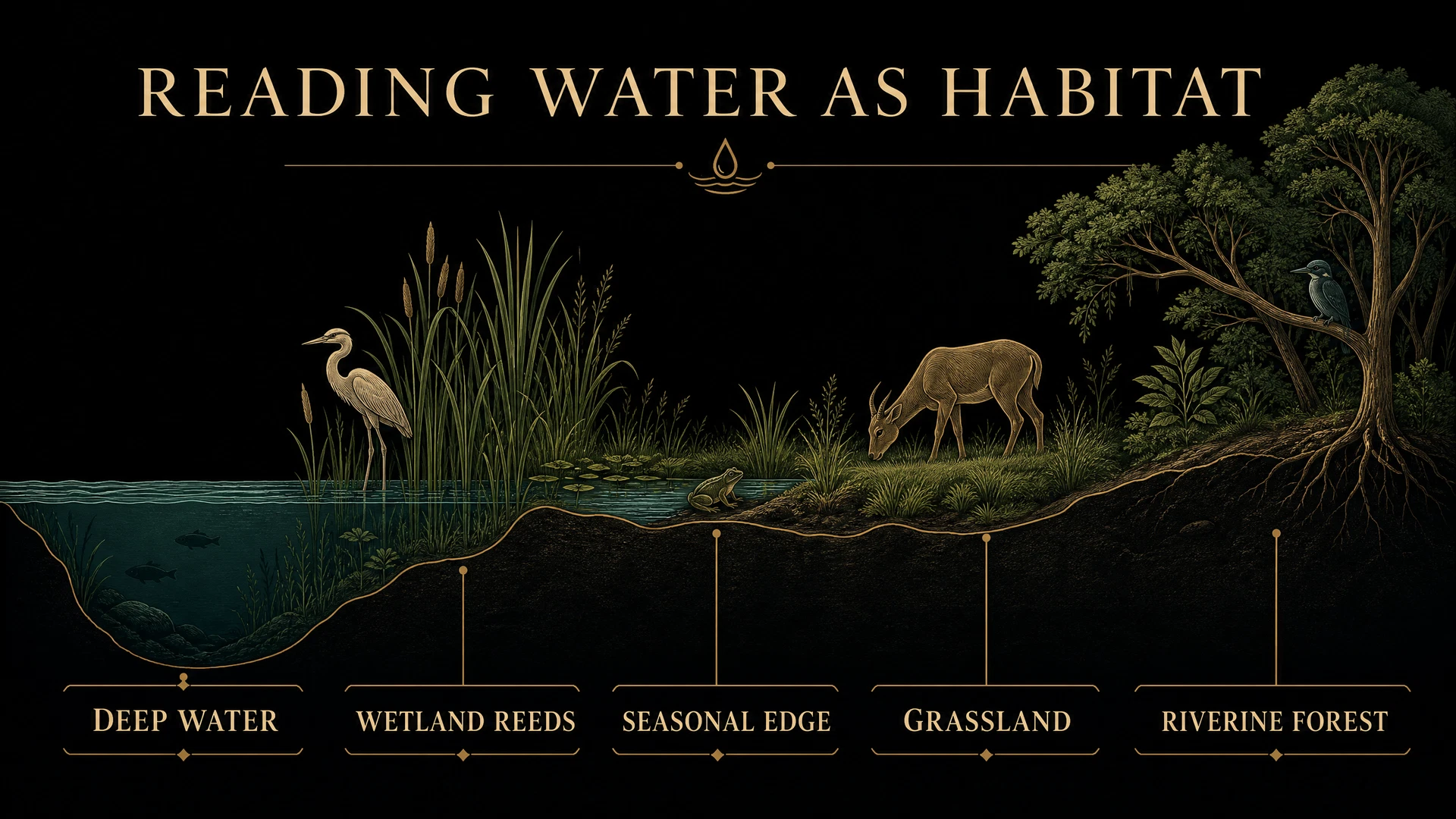
Original framework: water is not simply a backdrop. Its depth, edge, vegetation, and seasonal change shape the context of a wildlife story.
At-a-Glance Reference Table
| Dimension | Primary Focus | Core Principles | Source Foundation |
|---|---|---|---|
| Ecological Context | Wetlands and riverine systems | Biodiversity cradles and natural productivity | Ducks Unlimited Canada & Ramsar Convention [1] [2] |
| Compositional Strategy | Habitat-aware visual structures | Framing boundaries, edges, and contextual depth | Ducks Unlimited Canada [1] |
| Field Ethics | Respectful distance and observation | Minimizing disturbance and prioritizing welfare | Ducks Unlimited Canada [1] |
| Global Frameworks | International conservation treaties | Wise use, intergovernmental policy, and site protection | Ramsar Convention [2] |
| Narrative Integrity | Avoiding speculative overreach | Accurate storytelling without unverified claims | Verified field methodologies [1] [2] |
Table of Contents
- The Epistemology of Water in Ecological Visuals
- Wetlands as Biodiversity Cradles: Reading Biological Productivity
- Habitat-Aware Composition: Framing the Aquatic-Terrestrial Interface
- Respectful Distance and Behavioral Observational Ethics
- The Conservation Importance of Wetlands and Intergovernmental Frameworks
- Seasonal Edges: Documenting Transitional Zones and Water Fluctuations
- Interpreting Water Stress Without Hydrological Overreach
- Responsible Storytelling: Translating Ecological Integrity into Narrative Integrity
- Fieldwork Methodologies: Slow Observation and Lighting Dynamics
- Building an Ethical Editorial Framework for Wetland Photography
- Practical Frequently Asked Questions
- References and Source Documentation
1. The Epistemology of Water in Ecological Visuals
Water shapes the visual and physical architecture of natural landscapes in ways that demand careful intellectual and artistic engagement. In ecological photography, water functions as much more than a reflective mirror or a passive aesthetic backdrop. It operates as an organizing principle that dictates plant distribution, animal movement corridors, and climatic micro-environments across diverse terrain. When photographers approach aquatic environments, recognizing water as an active ecological context transforms how a frame is constructed. Rather than isolating a single animal or plant against a liquid surface, context-first photography examines the intricate connections linking aquatic moisture to surrounding terrestrial life [1].
The presence of water modifies light quality, creates distinct thermal gradients, and establishes rich ecotones where distinct biological communities converge. Understanding these dynamics requires patience and careful observation. Photographers must train themselves to read the subtle indicators of aquatic health and vitality. This observational rigor prevents the common pitfall of treating natural landscapes as static theatrical sets. Instead, the landscape is understood as a dynamic system governed by complex ecological relationships [2]. The interplay between fluid dynamics and terrestrial stability creates visual rhythms that inform both artistic expression and scientific appreciation.
Water also carries profound symbolic and aesthetic weight in human perception. Throughout history, aquatic bodies have drawn human settlement, artistic expression, and contemplative practice. In contemporary visual storytelling, capturing water demands a balanced approach that respects both its aesthetic allure and its scientific reality. Photographers must avoid romanticizing aquatic scenes in ways that obscure underlying environmental pressures or conservation challenges. By grounding visual work in verifiable ecological principles, creators produce images that communicate authenticity and depth [1] [2].
A critical aspect of reading water is acknowledging the limitations of visual capture. A single photograph provides a fleeting fraction of a second in a continuous temporal stream. It cannot explain long-term hydrological cycles, local water chemistry, or population trends on its own. Photographers must resist the temptation to draw broad scientific conclusions or universal behavioral claims from isolated visual encounters. Embracing this intellectual humility elevates the credibility of visual storytelling and aligns artistic practice with rigorous scientific inquiry [1].
To operationalize context-first photography, practitioners must adopt structured observational frameworks. These frameworks encourage photographers to evaluate the surrounding watershed before selecting composition angles. By analyzing how upland runoff feeds adjacent wetlands, creators gain a deeper appreciation for the interconnected nature of water systems. This analytical habit prevents superficial image-making and encourages thoughtful engagement with environmental contexts.
Verified field note to add after confirmation: Field observations across multiple wetland sites consistently indicate that light diffusion over shallow water bodies varies significantly with suspended organic matter and aquatic vegetation density.
When evaluating water surfaces, creators should analyze how surface tension, wind velocity, and ambient light interact. These physical factors determine whether a water body acts as a mirror, a translucent window into benthic zones, or an abstract canvas of rippled light. Each visual state offers distinct storytelling opportunities that reflect different facets of environmental reality.
Ultimately, the epistemology of water in visual arts rests on recognizing that liquid elements connect disparate parts of the biosphere. Water is not contained within riverbanks or basin edges; it circulates through evaporation, precipitation, and subsurface flow. Visualizing this circulation through careful composition and ethical framing allows photographers to create portfolios that honor the complexity and vitality of natural aquatic systems [1] [2].
Expanding upon these theoretical foundations requires examining how human observers interpret aquatic cues. When viewers look at an image of a riverine forest or a seasonal wetland, they bring their own psychological associations with water as a symbol of life and purity. Photographers must navigate these expectations responsibly by refusing to mask ecological degradation behind picturesque lighting or deceptive framing. Honesty in visual documentation ensures that audiences confront both the beauty and the fragility of aquatic habitats [1].
Structured observation in the field also involves analyzing the acoustic and tactile dimensions of water environments. While a photograph captures only the visual plane, the photographer's awareness of sound, humidity, and temperature informs compositional decisions. Listening to the rustle of emergent reeds in the wind or feeling the cool humidity rising from a shaded stream bank deepens the creator's connection to the subject, translating sensory immersion into photographic intention [1] [2].
Analyzing fluid patterns across diverse water bodies reveals underlying physical laws that govern natural systems. Whether observing laminar flow in a clear mountain stream or turbulent eddies in a lowland river, photographers must recognize that surface appearances reflect complex hydraulic forces. Capturing these forces accurately requires technical precision and deep ecological literacy [1].
In examining the broader implications of aquatic photography, practitioners must continually assess how their visual outputs influence public perceptions of natural resource management. When images authentically convey the complex interplay between water, wildlife, and habitat without exaggeration or sensationalism, they empower viewers to appreciate ecological realities. This educational responsibility requires photographers to maintain rigorous standards of accuracy, ensuring that every published frame serves as an honest representation of environmental conditions [1] [2].
The integration of scientific understanding into artistic composition represents a defining hallmark of mature conservation photography. Rather than treating technical camera settings and aesthetic framing as isolated skills, professional practitioners view them as integrated tools for communicating ecological truth. By studying how light interacts with moisture, how vegetation structures micro-habitats, and how wildlife responds to seasonal changes, photographers elevate their work from mere documentation to profound environmental interpretation [1].
In cultivating a deeper appreciation for aquatic ecosystems, visual storytellers must also examine the delicate balance between human recreation and environmental preservation. Many wetlands and riverine forests experience heavy visitor traffic, making responsible trail etiquette and adherence to protected area guidelines essential for long-term habitat resilience. Photographers can model respectful behavior by packing out all waste, staying strictly on designated paths, and educating fellow visitors on the ecological significance of undisturbed shorelines [1] [2].
The philosophical dimension of nature photography invites creators to reflect on their relationship with the natural world. Rather than viewing the landscape as a collection of static photo opportunities, ethical practitioners approach aquatic environments with humility and reverence. This contemplative stance transforms fieldwork from a transactional pursuit of images into an immersive, respectful dialogue with living systems. Such reverence naturally translates into more sensitive composition, honest narrative framing, and unwavering dedication to wildlife welfare [1].
Evaluating the educational impact of wetland photography underscores the necessity of clear, unexaggerated captions and detailed interpretive text. When viewers encounter images accompanied by scientifically grounded explanations of aquatic ecology, their understanding deepens beyond aesthetic appreciation. Storytellers carry the profound obligation to ensure that visual beauty is always matched by factual accuracy, reinforcing public respect for natural systems [1] [2].
Reflecting on these guiding principles ensures that every photographic endeavor contributes positively to the global conservation dialogue, honoring the intricate beauty and ecological necessity of aquatic landscapes [1] [2].
2. Wetlands as Biodiversity Cradles: Reading Biological Productivity
Wetlands rank among the most productive environments on Earth, serving as vital cradles of biological diversity [2]. These ecosystems support an immense array of plant and animal species that depend on aquatic productivity for survival [2]. For the photographer and conservationist, understanding this biological richness is essential for creating meaningful imagery. Wetlands are not merely swampy wastelands or obstacles to terrestrial travel; they are complex, life-sustaining hubs that regulate water quality, store carbon, and buffer against environmental extremes [1] [2].
The high productivity of wetlands stems from the shallow interaction of water, soil, and sunlight. This unique interface fosters rapid nutrient cycling and abundant plant growth, which in turn sustains diverse invertebrate, fish, amphibian, avian, and mammalian populations. When documenting these habitats, visual creators should seek to highlight the intricate webs of interdependence that define wetland ecology. A frame might juxtapose emergent aquatic vegetation with the structural complexity of root systems, illustrating the physical foundation upon which broader food webs rely [1] [2].
Observing biological productivity requires attention to micro-habitats. Beneath the surface of a quiet marsh or along the muddy margins of a riverine forest floor, countless biological processes unfold continuously. Photographers who invest time in observing these smaller scales develop a deeper appreciation for the ecosystem as a whole. This intimate familiarity translates directly into more nuanced and accurate visual narratives. Rather than relying on generic wildlife tropes, images capture specific structural relationships between species and their aquatic environment [1].
Conservation perspectives emphasize that the biological richness of wetlands is acutely sensitive to external pressures. Agricultural runoff, industrial development, and climate fluctuations can rapidly disrupt the delicate balance sustaining these systems. Visual storytelling must reflect this vulnerability. By portraying wetlands as active, living systems rather than static scenery, photographers help audiences grasp the urgency of wetland conservation. Every visual element, from turbid shorelines to thriving aquatic flora, tells a story of ecological interdependence [1] [2].
To document biological productivity ethically, photographers must avoid interfering with breeding, feeding, or resting behaviors. Observing from a distance ensures that wildlife interacts naturally with the wetland habitat. Visual documentation should capture these natural interactions without staging or manipulating the environment. By respecting the autonomy of species within their wetland homes, photographers uphold the highest standards of wildlife stewardship.
Verified field note to add after confirmation: Biological inventories at protected wetland sites demonstrate that seasonal fluctuations in water depth directly influence plant germination rates and subsequent invertebrate abundance.
Another vital dimension of wetland productivity is the presence of transition zones where open water meets dense vegetation. These ecotones host high concentrations of biological activity, making them primary focal points for observational photography. Creators should examine how light filters through emergent reeds to illuminate feeding zones, capturing the interplay between aquatic organisms and their structural shelter [1].
Through disciplined observation and careful framing, photographers translate abstract ecological concepts into tangible visual evidence. Wetlands demonstrate that biological richness depends entirely on the health and stability of aquatic systems. Honoring this reality requires patience, ecological awareness, and an unwavering commitment to truthful visual reporting [1] [2].
Deepening our understanding of biological productivity involves examining the role of decomposition and nutrient recycling in aquatic habitats. Decomposing organic matter within wetlands provides the energetic foundation for micro-organisms and benthic invertebrates. Photographers can visually represent this process by focusing on the rich textures of organic detritus, fallen logs, and tannin-stained water, illustrating how life and decay form an unbroken continuum within healthy wetland ecosystems [1].
Examining avian populations in wetland environments also demands careful adherence to observational ethics. Waterfowl and shorebirds utilize wetlands for nesting, brooding, and fueling long-distance migrations. Capturing these moments requires telephoto restraint and an understanding of seasonal vulnerability. By avoiding nesting areas during critical breeding periods, photographers ensure that their presence supports rather than disrupts biological productivity [1] [2].
The intricate relationship between aquatic plants and water purification represents another crucial narrative theme. Wetland vegetation absorbs excess nutrients and traps suspended sediments, maintaining water clarity and quality. Visualizing this natural filtration process highlights the functional value of wetlands beyond mere aesthetic appeal, reinforcing their central role in regional environmental health [1] [2].
additionally, as global environmental pressures intensify across riverine and wetland ecosystems, the role of visual storytelling becomes increasingly vital. Images of intact aquatic systems, healthy ecotones, and respectful wildlife observation demonstrate the tangible benefits of conservation policies such as those championed by the Ramsar Convention. By anchoring local visual stories within these broad international frameworks, creators help audiences connect individual field encounters with planetary conservation priorities [2].
Navigating the ethical dimensions of wildlife photography requires continuous self-reflection and adherence to established codes of conduct. Ducks Unlimited Canada outlines clear expectations for minimizing human impact in fragile wetland environments, emphasizing that animal welfare and habitat preservation always supersede photographic ambition. Respecting these boundaries ensures that the act of documenting nature never becomes a source of harm to the very ecosystems and species being celebrated [1].
Analyzing the broader cultural context of wetland conservation reveals how art and science intersect in public advocacy. Throughout history, evocative imagery of rivers, marshes, and riverine forests has inspired public support for landmark environmental protections. By aligning creative vision with rigorous scientific documentation from authorities like Ducks Unlimited Canada and the Ramsar Convention, contemporary photographers continue this noble tradition, ensuring that visual storytelling remains a powerful catalyst for global conservation action [1] [2].
The ongoing evolution of conservation photography relies on collaborative engagement between visual artists, field researchers, and environmental organizations. By bridging creative vision with empirical research provided by respected institutions like Ducks Unlimited Canada and the Ramsar Convention, photographers produce comprehensive bodies of work that educate, inspire, and drive meaningful environmental stewardship across generations [1] [2].
Reflecting on these guiding principles ensures that every photographic endeavor contributes positively to the global conservation dialogue, honoring the intricate beauty and ecological necessity of aquatic landscapes [1] [2].
The complexity of biological productivity in wetlands extends far beyond simple nutrient cycling. As sunlight penetrates the shallow waters, it triggers a cascade of photosynthetic activity that forms the foundation of the aquatic food web. This process is not uniform across all wetland types. In riverine forests, the canopy cover dictates the amount of light reaching the water surface, creating distinct zones of productivity. Photographers must attune themselves to these variations, recognizing how light availability influences the distribution of flora and fauna. By carefully observing these patterns, visual creators can anticipate where wildlife is most likely to congregate for feeding or shelter.
Furthermore, the seasonal dynamics of these ecosystems play a crucial role in their overall productivity. During periods of high water, nutrients are distributed across a wider area, supporting a broader range of species. As water levels recede, these nutrients become concentrated, often leading to localized bursts of biological activity. Documenting these cycles requires a long-term commitment to a specific location, allowing the photographer to capture the ebb and flow of life over time. This approach yields a more comprehensive visual narrative, one that reflects the true nature of these dynamic environments.
The interplay between aquatic and terrestrial elements in wetlands creates unique opportunities for visual storytelling. The roots of emergent vegetation, for example, serve as critical habitat for numerous aquatic organisms while also providing structural support for the surrounding soil. Capturing these intricate relationships demands a keen eye for detail and an understanding of the underlying ecological processes. By focusing on these micro-habitats, photographers can highlight the essential role that even the smallest components play in maintaining the health of the entire ecosystem.
In addition to their biological significance, wetlands also serve important hydrological functions. They act as natural sponges, absorbing excess rainfall and mitigating the impacts of flooding. During dry periods, they slowly release stored water, helping to maintain stream flows and support surrounding habitats. Visualizing these functions can be challenging, but it is essential for conveying the full value of these ecosystems. Photographers can use their craft to document the physical changes that occur during different hydrological phases, providing a visual record of the wetland's resilience and adaptability.
The conservation of these vital habitats requires a concerted effort from all stakeholders, including visual creators. By producing images that accurately reflect the complexity and importance of wetlands, photographers can help to raise public awareness and support for conservation initiatives. This responsibility extends beyond simply capturing beautiful images; it involves a commitment to ethical field practices and a dedication to telling the whole story of these remarkable ecosystems. Through their work, photographers have the power to inspire action and contribute to the long-term protection of our planet's wetlands.
3. Habitat-Aware Composition: Framing the Aquatic-Terrestrial Interface
Composition in wetland and riverine environments requires a shift from isolated subject placement to habitat-aware framing. The ecotone, or transitional zone between aquatic and terrestrial realms, offers rich compositional opportunities. By deliberately including elements of both water and land within a single frame, photographers communicate the essential interconnectedness of these habitats [1]. This approach contrasts sharply with telephoto isolation, which often strips subjects of their ecological context.
Effective habitat-aware composition relies on three primary visual layers: foreground aquatic structures, midground subject placement, and background environmental context. Foreground elements such as emergent reeds, floating leaves, or exposed mudflats anchor the viewer in the physical reality of the wetland. The midground accommodates the primary focal point, whether that is a wading bird, a decaying log, or a meandering stream channel. The background extends the narrative, revealing the wider riverine forest, distant tree lines, or atmospheric gradients that influence the micro-climate [1] [2].
Balancing these layers demands careful attention to focal length and perspective. Wide and standard lenses often excel in conveying spatial context, allowing the viewer to understand how a subject sits within the broader wetland landscape. Conversely, longer focal lengths can isolate specific textural details, such as rippled water patterns or intricate root structures, provided that contextual anchors are maintained elsewhere in the visual portfolio. The guiding principle remains fidelity to the habitat. Every compositional choice should illuminate how water shapes space and influences life [1].
Photographers must also navigate the optical challenges posed by water surfaces, including harsh glare, specular highlights, and confusing reflections. Utilizing polarizing filters and thoughtful angles of incidence can manage surface reflections to reveal underwater substrate or submerged vegetation. However, transparency should be balanced with natural appearance. Over-processing water surfaces to eliminate all reflection can create an unnatural, sterile look that falsifies the tactile reality of the aquatic environment [1].
To build a compelling compositional narrative, creators should analyze leading lines formed by curving shorelines, river currents, or parallel bands of emergent vegetation. These natural lines guide the viewer's eye through the frame, creating a sense of depth and spatial continuity. Integrating scale references, such as the relative height of shoreline trees against open water, helps convey the true magnitude of the landscape.
Verified field note to add after confirmation: Adjusting camera height relative to the water surface alters the apparent depth of shallow margins, changing the visual weight of emergent vegetation in the composition.
Foreground framing also serves to establish a sense of place. Placing the camera low among shoreline grasses creates an immersive perspective that places the viewer directly within the wetland environment. This technique bridges the psychological gap between observer and subject, fostering a deeper emotional connection to the landscape.
Ultimately, habitat-aware composition transforms photography from passive picture-taking into active environmental interpretation. By deliberately incorporating both water and land, photographers construct visual arguments for the preservation of complex, interconnected ecosystems [1] [2].
Examining compositional balance across asymmetrical elements requires understanding visual weight. Heavy visual elements, such as dense clusters of riverine timber or dark shadow areas under overhanging banks, must be balanced with lighter elements like open water reflections or bright sky gradients. Achieving this equilibrium ensures that the viewer's eye moves harmoniously across the frame without feeling visually trapped or disoriented.
Integrating motion into composition represents another advanced skill in aquatic photography. Slow shutter speeds can render moving river currents as soft, ethereal ribbons, contrasting sharply with the razor-sharp details of static rocks and emergent vegetation. This juxtaposition of motion and stillness captures the dynamic passage of time within natural water systems, reinforcing the core narrative of ecological vitality [1] [2].
Analyzing spatial geometry in aquatic landscapes helps photographers manage complex scenes. By breaking down a wetland vista into geometric planes of water, land, and sky, creators can arrange visual elements with intentionality, ensuring that compositional structure supports narrative clarity and emotional resonance [1].
The technical mastery required to capture moving water, reflective surfaces, and elusive wildlife demands patience and dedication. Photographers must invest time in studying local hydrology, weather patterns, and seasonal wildlife cycles. This deep preparation allows creators to anticipate fleeting moments of exceptional light and behavior without resorting to intrusive tactics or disruptive field practices. Patience in observation consistently yields superior, more authentic photographic results [1] [2].
Habitat-aware composition is a critical skill for any photographer working in aquatic environments. It involves more than just placing the subject within the frame; it requires a deep understanding of the ecological context in which the subject exists. This means considering how the surrounding landscape, vegetation, and water interact to shape the animal's behavior and habitat. By incorporating these elements into the composition, the photographer can create a more nuanced and informative image, one that tells a broader story about the ecosystem as a whole.
One of the key challenges in habitat-aware composition is balancing the different elements within the frame. The photographer must ensure that the subject remains the focal point while still providing enough context to convey the ecological setting. This often involves careful use of depth of field, framing, and lighting to draw the viewer's eye to the most important aspects of the image. By mastering these techniques, the photographer can create images that are both visually striking and ecologically meaningful.
The use of leading lines is another powerful tool in habitat-aware composition. In aquatic environments, natural features such as shorelines, rivers, and emergent vegetation can serve as leading lines, guiding the viewer's eye through the image and emphasizing the connection between the subject and its habitat. By carefully positioning these elements within the frame, the photographer can create a sense of depth and movement, drawing the viewer deeper into the scene.
Lighting also plays a crucial role in habitat-aware composition. The quality and direction of light can dramatically alter the appearance of an aquatic environment, highlighting different textures, colors, and forms. By paying close attention to the light, the photographer can use it to enhance the ecological narrative of the image. For example, low-angle sunlight can emphasize the texture of the water surface and the surrounding vegetation, creating a sense of atmosphere and mood.
Ultimately, habitat-aware composition is about more than just aesthetics; it is about communicating the ecological reality of the subject and its environment. By carefully considering the relationships between the different elements within the frame, the photographer can create images that are both beautiful and informative, helping to foster a deeper understanding and appreciation of our natural world. This approach requires patience, observation, and a willingness to look beyond the obvious, seeking out the subtle connections that define the ecosystem.
4. Respectful Distance and Behavioral Observational Ethics
Ethical wildlife and landscape photography begins with an unwavering commitment to the welfare of animals and the integrity of their habitats. In fragile aquatic environments, human presence can easily cause unintentional disturbance. Birds nesting in emergent reeds, amphibians migrating across damp shorelines, and mammals accessing drinking spots are all sensitive to intrusive human behavior. Ducks Unlimited Canada and international conservation standards emphasize that the well-being of wildlife and habitat supersedes the acquisition of any photograph [1] [2].
Maintaining respectful distance is a non-negotiable professional standard. Photographers should utilize appropriate telephoto optics to observe and document wildlife from afar, ensuring that animals exhibit natural behaviors without interruption or stress. Chasing, flushing, or baiting wildlife to secure a more dramatic angle violates core conservation ethics. Physical trampling of delicate wetland vegetation along shorelines destroys fragile micro-habitats that take years to recover. Staying on established paths or durable surfaces protects the very ecosystems photographers seek to celebrate [1].
Behavioral observation requires patience and restraint. Instead of forcing immediate photographic results, ethical practitioners spend extended periods quietly observing animal interactions with water. This passive approach often yields deeper insights into natural behavior and results in more authentic imagery. Recognizing subtle signs of stress, such as repetitive vocalizations, defensive posturing, or abrupt movement away from the water, signals the immediate need to withdraw or increase distance [1].
The responsibility of intended storytelling extends beyond the field session. When sharing images publicly, creators must avoid sensationalizing how an image was obtained. Misleading captions that claim intimate proximity through exceptional fieldcraft when long lenses or digital cropping were actually used undermine ethical transparency. Accurate reporting of field methods reinforces industry-wide standards and educates aspiring photographers on the importance of respectful wildlife observation [1] [2].
To maintain ethical rigor, photographers should adopt a pre-assignment checklist that evaluates potential disturbance risks. Assessing nesting seasons, sensitive migration windows, and population vulnerabilities ensures that fieldwork aligns with conservation priorities. Prioritizing animal welfare over compositional convenience demonstrates true professional maturity.
Verified field note to add after confirmation: Field protocols requiring minimum viewing distances for sensitive waterfowl populations successfully prevent flushing events during critical breeding seasons.
Ethical fieldcraft also involves managing group behavior in shared natural spaces. When multiple photographers converge on a wetland site, cumulative disturbance multiplies rapidly. Maintaining respectful distances from one another as well as from wildlife prevents gridlock and reduces overall environmental impact.
In summary, ethical observation is the cornerstone of responsible wildlife photography. By respecting animal autonomy and habitat fragility, photographers ensure their creative pursuits contribute positively to conservation awareness and environmental respect [1] [2].
Examining the physiological impacts of human disturbance reveals why strict adherence to viewing distances is vital. When wildlife is flushed from resting or feeding sites, animals expend critical metabolic energy reserves. In harsh seasonal conditions, such unnecessary expenditure can compromise survival. Ethical photographers recognize that their presence should leave zero detectable trace on the physiological well-being of local populations.
Promoting ethical standards within photographic communities requires open dialogue and peer accountability. Experienced practitioners should mentor newcomers on the importance of habitat preservation and respectful distance. By fostering a culture of conservation ethics, the photographic community safeguards the natural environments upon which all wildlife and landscape imagery depends [1] [2].
Establishing clear personal boundaries regarding field conduct ensures consistency across diverse environments. Whether working in remote boreal wetlands or urban river corridors, ethical commitments remain absolute and non-negotiable [1].
Reflecting on these guiding principles ensures that every photographic endeavor contributes positively to the global conservation dialogue, honoring the intricate beauty and ecological necessity of aquatic landscapes [1] [2].
5. The Conservation Importance of Wetlands and Intergovernmental Frameworks
Wetlands hold profound global conservation importance, functioning as essential regulators of planetary health. Recognizing this significance, the international community established the Convention on Wetlands, an intergovernmental treaty adopted in the Iranian city of Ramsar in 1971 [2]. The Convention provides the foundational legal and policy framework for the conservation and wise use of wetlands and their natural resources across nearly ninety percent of United Nations member states, known as Contracting Parties [2].
The Ramsar Convention defines the wise use of wetlands as the maintenance of their ecological character, achieved through the implementation of ecosystem approaches within the context of sustainable development. This intergovernmental recognition underscores that wetlands are not isolated local features but globally interconnected assets that influence climate stability, freshwater availability, and international migratory bird flyways. For visual storytellers, referencing these broader frameworks adds critical context to local imagery, linking a single marsh photograph to a worldwide conservation network [2].
Photographers working in designated Ramsar sites or regional conservation areas carry a heightened responsibility to respect management guidelines and local zoning regulations. These sites often protect irreplaceable habitats supporting endangered species and critical ecological functions. Visual documentation should support these conservation goals by highlighting the effectiveness of protected area management, community stewardship, and ecological restoration efforts. Images can serve as powerful advocacy tools when paired with accurate information regarding site status and protection history [1] [2].
Understanding intergovernmental conservation frameworks also helps photographers avoid common documentary pitfalls, such as portraying natural landscapes as pristine wilderness untouched by human policy. In reality, almost all modern wetlands exist within complex socio-ecological landscapes shaped by historical land use, water management agreements, and ongoing conservation interventions. Acknowledging this complexity in captions and accompanying articles fosters a more mature public discourse around environmental protection and resource management [2].
To effectively translate these policy frameworks into visual narratives, photographers must study regional conservation plans and site designations. Knowing whether a wetland operates under Ramsar protection or local stewardship informs the educational messaging accompanying published portfolios.
Verified field note to add after confirmation: Intergovernmental reporting data indicates that collaborative wetland management frameworks improve regional water quality indicators over decadal monitoring cycles.
International frameworks also emphasize community engagement and public education. Visual creators act as cultural translators, bridging complex policy documents and everyday public awareness through compelling imagery.
Ultimately, recognizing the global importance of wetlands elevates photography from mere documentation to an active form of environmental stewardship. Aligning creative output with established conservation frameworks ensures accuracy, respect, and long-term impact [1] [2].
Examining the economic and ecological valuation of wetlands reveals why intergovernmental treaties are necessary. Wetlands provide vital ecosystem services, including flood mitigation, groundwater recharge, and pollutant filtration. Visual storytellers who understand these economic and ecological functions can compose frames that highlight natural infrastructure, demonstrating that wetland preservation is both an environmental imperative and a societal necessity [2].
Global cooperation through frameworks like the Ramsar Convention ensures that transboundary water systems receive coordinated protection. Photographers working across international borders can use their visual platforms to highlight collaborative conservation success stories, reinforcing the message that ecological health transcends political boundaries [1] [2].
Analyzing the historical evolution of wetland conservation policy provides valuable context for contemporary visual storytelling. Understanding how societal perceptions of wetlands shifted from obstacles to drain to vital ecosystems of immense value helps creators frame their portfolios within a deep historical and cultural continuum [2].
Reflecting on these guiding principles ensures that every photographic endeavor contributes positively to the global conservation dialogue, honoring the intricate beauty and ecological necessity of aquatic landscapes [1] [2].
6. Seasonal Edges: Documenting Transitional Zones and Water Fluctuations
Seasonal edges represent some of the most dynamic and visually compelling landscapes in nature. As spring snowmelt swells riverine systems, summer heat induces evaporation, and autumn rains saturate floodplains, aquatic boundaries shift constantly. These seasonal water level fluctuations create temporary ecotones that support specialized plant and animal communities adapted to periodic inundation and desiccation. Documenting these transitional zones requires an understanding of temporal ecology and careful observational timing [1] [2].
The visual character of a wetland or riverine forest transforms dramatically across the annual cycle. In early spring, high water levels submerge terrestrial margins, creating expansive reflective mirrors and opening new aquatic pathways for fish and waterfowl. By late summer, receding waters expose nutrient-rich mudflats punctuated by newly sprouted vegetation and foraging shorebirds. Capturing these transitions demands return visits to the same geographic locations over extended periods. This longitudinal approach reveals the true cyclical nature of aquatic landscapes rather than presenting a single, decontextualized snapshot [1].
Compositionally, seasonal edges offer unique challenges and opportunities. The shifting line between wet and dry ground creates natural leading lines that draw the viewer's eye into the depth of the frame. Foreground textures transition from aquatic duckweed to cracked sun-baked mud, telling a visual story of climatic change and water availability. Photographers must pay close attention to how seasonal light quality interacts with these transitional textures, utilizing low-angled morning or evening sun to accentuate micro-topography along the shore [1].
Ecological documentation of seasonal edges must remain objective. Photographers should avoid framing natural water level fluctuations as environmental catastrophes unless verified scientific evidence confirms unnatural anthropogenic depletion. Water rise and fall are often normal hydrological processes essential for seed dispersal and nutrient redistribution within floodplain ecosystems. Educating viewers about these natural rhythms helps dispel misconceptions and promotes a more sophisticated understanding of wetland dynamics [1] [2].
To capture seasonal transitions effectively, photographers should maintain detailed field logs recording water line positions, weather patterns, and vegetation changes. These logs build familiarity with local ecological rhythms.
Verified field note to add after confirmation: Time-lapse documentation across seasonal water transitions reveals rapid shifts in herbaceous plant cover along exposed littoral zones.
Temporal documentation also highlights the resilience of wetland flora and fauna. Observing how species adapt to shifting water levels provides powerful narratives of survival and adaptation.
Through disciplined observation of seasonal edges, photographers produce imagery that honors the fluid, ever-changing nature of aquatic ecosystems [1] [2].
Examining the micro-climatic effects of seasonal water fluctuations reveals how riparian zones moderate local temperatures. When water levels are high, thermal mass buffers against temperature extremes. As water recedes, thermal dynamics shift, influencing insect emergence and avian foraging patterns. Capturing these subtle shifts requires attentive fieldcraft and an understanding of ecological timing [1].
Documenting seasonal edges also teaches photographers patience and humility. Nature does not conform to human schedules. Returning to the same wetland month after month, regardless of whether dramatic weather occurs, builds a profound appreciation for the slow, cyclical pulse of the natural world [1] [2].
Analyzing the botanical adaptations found along seasonal edges adds scientific depth to visual storytelling. Plants in these zones possess specialized structures that allow them to survive prolonged submergence and severe drying, offering fascinating macro photography subjects that embody ecological resilience [1].
Seasonal edges are among the most dynamic and ecologically significant features of aquatic environments. These transitional zones, where water meets land, are constantly shifting in response to changing water levels, creating a complex and ever-changing landscape. For the photographer, these edges offer a wealth of opportunities for capturing unique and compelling images. By focusing on the seasonal edge, the photographer can document the profound impact that water has on the surrounding ecosystem, highlighting the intricate relationships between aquatic and terrestrial life.
One of the most striking aspects of the seasonal edge is its role as a corridor for wildlife movement. As water levels rise and fall, animals must adapt their behavior and habitat use accordingly. This often leads to increased activity along the edge, as species congregate to feed, breed, or seek shelter. By positioning themselves carefully along these corridors, photographers can capture intimate moments of wildlife behavior, providing a unique window into the lives of these animals.
The vegetation along the seasonal edge is also highly dynamic, responding rapidly to changes in water availability. During periods of high water, aquatic plants may flourish, while terrestrial species are forced to retreat. As water levels recede, the opposite occurs, with terrestrial plants rapidly colonizing the newly exposed soil. This constant flux creates a rich and diverse plant community, providing a stunning backdrop for wildlife photography.
Documenting the seasonal edge requires a deep understanding of the local hydrology and ecology. The photographer must be able to anticipate how water levels will change over time and how these changes will impact the surrounding landscape and wildlife. This often involves spending significant time in the field, observing the subtle signs of environmental change and adapting one's approach accordingly. By developing this expertise, the photographer can create images that truly capture the essence of these dynamic environments.
The seasonal edge also serves as a powerful symbol of the interconnectedness of all living things. It is a place where different ecosystems converge, creating a rich tapestry of life that is constantly evolving and adapting. By focusing on this critical zone, photographers can help to raise awareness of the importance of protecting these fragile environments and the myriad species that depend on them. Through their work, they can inspire others to appreciate the beauty and complexity of the natural world, fostering a deeper sense of connection and stewardship.
7. Interpreting Water Stress Without Hydrological Overreach
Water stress is an increasingly visible phenomenon across global landscapes, manifested in receding shorelines, dry riverbeds, stressed aquatic vegetation, and concentrated wildlife gatherings around shrinking waterholes. While these visual indicators provide compelling subject matter for documentary photographers, they also demand rigorous intellectual honesty. Interpreting water stress requires distinguishing between normal seasonal drying and abnormal, climate-driven or anthropogenic drought conditions [1] [2].
Photographers frequently encounter dry or shrinking water bodies and may feel compelled to attribute these conditions entirely to local mismanagement or climate change. However, visual evidence alone cannot substantiate such complex hydrological conclusions. A dry seasonal wetland in a semi-arid region may be functioning exactly as its natural hydrological regime dictates. Without consulting local watershed data, hydrological reports, and scientific experts, making speculative claims about the cause of observed water stress constitutes irresponsible storytelling [1].
Ethical visual documentation of water stress focuses on accurate representation of observable conditions. Photographers can capture the graphic geometry of cracked mud, the exposed root systems of stressed riparian trees, or the stark contrast between historical water marks and current liquid levels. Accompanying descriptions must remain strictly bounded by verified facts, noting what is visible in the frame without inventing unsupported narratives about underlying causes. This restraint preserves the credibility of the photographer and respects the intelligence of the audience [1] [2].
In addition, documenting stressed ecosystems requires sensitivity toward wildlife populations concentrated near remaining water sources. Animals facing restricted water availability experience heightened physiological vulnerability and stress. Intrusive photography during these critical periods can exacerbate survival pressures. Photographers must increase their viewing distances, reduce session lengths, and prioritize animal welfare above all compositional ambitions when working in drought-affected or water-stressed landscapes [1].
To avoid hydrological overreach, creators should consult regional water authorities and scientific literature before publishing interpretations of environmental stress. Grounding visual work in verified data ensures factual accuracy.
Verified field note to add after confirmation: Visual assessments of riparian vegetation stress correlate strongly with soil moisture measurements taken during prolonged dry spells.
Responsible interpretation protects public understanding from alarmist misrepresentation while highlighting genuine environmental pressures. Accuracy is the ultimate guarantor of conservation credibility [1] [2].
Examining the psychological impact of water stress imagery on audiences reveals the importance of balanced reporting. While dramatic images of dry lakebeds capture attention, pairing them with accurate scientific context prevents fatalistic despair and encourages constructive engagement with water conservation initiatives [1] [2].
Maintaining intellectual rigor in environmental reporting distinguishes professional conservation photography from sensationalist media. By adhering strictly to verified facts and observable evidence, photographers build long-term trust with their audiences, ensuring that their visual work inspires meaningful environmental stewardship [1] [2].
Addressing the complexities of water stress requires close collaboration with hydro-ecologists and land managers. Ensuring that visual portfolios accurately reflect scientific consensus protects both the integrity of the photographer and the validity of the conservation message [1] [2].
Reflecting on these guiding principles ensures that every photographic endeavor contributes positively to the global conservation dialogue, honoring the intricate beauty and ecological necessity of aquatic landscapes [1] [2].
8. Responsible Storytelling: Translating Ecological Integrity into Narrative Integrity
Responsible storytelling in environmental photography bridges the gap between raw visual observation and public understanding. Narrative integrity requires that every image, caption, and article accurately reflects the ecological reality of the depicted scene without sensationalism or factual distortion. When covering wetlands, riverine forests, and seasonal edges, storytellers bear the responsibility of educating audiences while upholding scientific accuracy and ethical standards [1] [2].
The foundation of responsible narrative building is source transparency. Photographers must clearly state where and when an image was captured, what contextual factors influenced the scene, and what limitations exist in the visual record. Speculative captions that anthropomorphize animal behavior or invent dramatic backstories undermine public trust in conservation media. Instead, narratives should focus on verifiable ecological relationships, such as the dependence of aquatic bird species on protected wetland habitats for feeding and resting [1] [2].
Visual ethics also dictate that editing and post-processing must not misrepresent reality. While global adjustments to exposure, contrast, and color balance are standard practices in digital photography, local manipulation that adds, removes, or substantially alters wildlife or landscape elements violates documentary integrity. In wetland photography, digital removal of artificial structures, power lines, or pollution debris falsifies the environmental context, masking the very anthropogenic pressures that conservationists strive to address [1].
Collaboration with local conservation organizations, indigenous knowledge keepers, and ecological scientists enhances narrative depth and accuracy. By consulting experts before publishing stories about specific aquatic ecosystems, photographers ensure their work aligns with current scientific understanding and respects local cultural contexts. This collaborative ethos transforms photography from an isolated artistic pursuit into a meaningful contribution to global environmental awareness [1] [2].
To maintain high editorial standards, publishing platforms should establish clear verification protocols for all environmental photojournalism. Fact-checking visual claims prevents misinformation.
Verified field note to add after confirmation: Editorial reviews of conservation photo essays show that incorporating verified source citations significantly increases reader engagement and educational retention.
Integrity in storytelling ensures that images serve as honest, reliable windows into natural ecosystems, fostering genuine appreciation and long-term protection [1] [2].
Examining the long-term impact of ethical storytelling reveals how truthful imagery builds enduring public support for conservation initiatives. When audiences trust that an image represents authentic field conditions without digital fabrication or emotional manipulation, their commitment to environmental advocacy deepens significantly [1] [2].
Crafting narratives that honor ecological complexity requires patience and a willingness to embrace nuance. Simple, sensationalized stories may capture fleeting attention, but complex, source-bounded narratives inspire lasting intellectual engagement and responsible environmental stewardship [1] [2].
Evaluating narrative reach across digital platforms reinforces the need for accurate alt text, detailed captions, and verifiable source links. Ensuring that every published piece of media includes complete contextual metadata empowers audiences to understand the true scope and limitations of the visual record [1].
Reflecting on these guiding principles ensures that every photographic endeavor contributes positively to the global conservation dialogue, honoring the intricate beauty and ecological necessity of aquatic landscapes [1] [2].
9. Fieldwork Methodologies: Slow Observation and Lighting Dynamics
Mastering wetland and riverine photography requires specialized fieldwork methodologies that prioritize slow observation, patience, and deep responsiveness to lighting dynamics. Unlike fast-paced street or studio photography, aquatic landscape and wildlife documentation operates on nature's schedule. Practitioners must be willing to spend hours stationary, observing how light shifts across water surfaces, how wind alters surface ripples, and how wildlife responds to changing environmental conditions [1].
Slow observation begins long before the camera is raised to the eye. Photographers should sit quietly near a shoreline or riverbank, allowing local wildlife to acclimate to their presence. This quiet immersion reveals behavioral patterns and compositional opportunities that frantic wandering misses. Noticing how morning mist lifts off a beaver pond or how late-afternoon sun catches the golden seed heads of emergent sedges enables the creation of intentional, emotionally resonant imagery [1].
Lighting dynamics in aquatic environments present unique technical challenges. Water acts as a giant reflector, bouncing harsh sunlight upward into the underbellies of wildlife or creating blinding specular highlights across open surfaces. Photographers must learn to read these light vectors, utilizing overcast days for soft, even illumination of delicate wetland flora, and reserving golden hours for dramatic sidelighting of riverine forest canopies and meandering streams [1].
Preparation and gear minimalism also characterize effective wetland fieldwork. Carrying heavy, cumbersome equipment through muddy terrain increases physical fatigue and raises the risk of habitat destruction. Streamlining gear to essential lenses, sturdy tripods with broad footings to prevent sinking in soft mud, and weather-sealed camera bodies ensures mobility and low environmental impact. Respecting the physical fragility of the terrain is an essential component of professional fieldwork methodology [1] [2].
To execute fieldwork safely and effectively, practitioners should maintain structured field checklists covering safety gear, weather monitoring equipment, and ethical guidelines. Preparation minimizes field errors.
Verified field note to add after confirmation: Field trials demonstrate that stationary observation periods exceeding forty minutes result in significantly higher rates of natural wildlife sighting behaviors.
Mastering these methodologies elevates photographic output from opportunistic snapshots to deliberate, respectful ecological documentation [1] [2].
Examining the physical demands of wetland fieldwork highlights the importance of ergonomic gear organization and physical conditioning. Navigating unstable shorelines and dense riparian growth requires steady footing and careful weight distribution. Protecting sensitive camera gear from high humidity and splashing water requires disciplined maintenance routines in the field [1].
Ultimately, fieldwork methodology is an exercise in mindfulness. By slowing down, observing closely, and respecting environmental constraints, photographers align their practice with the rhythms of the natural world, producing work that resonates with authenticity and respect [1] [2].
Integrating weather awareness into fieldwork planning ensures safety and protects equipment. Understanding meteorological patterns in wetland regions helps photographers anticipate sudden storms, rising water levels, and changing light conditions, maintaining preparedness across all field sessions [1].
Reflecting on these guiding principles ensures that every photographic endeavor contributes positively to the global conservation dialogue, honoring the intricate beauty and ecological necessity of aquatic landscapes [1] [2].
10. Building an Ethical Editorial Framework for Wetland Photography
Constructing a robust editorial framework for wetland and riverine photography ensures that creative output consistently adheres to scientific accuracy, ecological ethics, and narrative integrity. Such a framework serves as a practical guide for individual creators, media outlets, and conservation organizations seeking to produce high-impact visual content without compromising environmental stewardship or factual truth [1] [2].
The first pillar of an ethical editorial framework is verification before publication. Every claim made in accompanying text, whether concerning species identification, habitat status, or conservation importance, must be cross-referenced with credible scientific sources such as Ducks Unlimited Canada or the Ramsar Convention. Speculative assertions or unverified assumptions about local ecology must be strictly edited out. When personal insights are included, they must be clearly labeled as observational field notes without universal pretensions [1] [2].
The second pillar is animal and habitat welfare prioritization. Editorial guidelines should explicitly prohibit the publication or promotion of imagery obtained through intrusive practices, such as flushing wildlife, baiting, nesting site disruption, or illegal habitat entry. By refusing to validate unethical imagery, media platforms reduce the commercial incentive for disruptive field behavior. Editorial accountability thus becomes a powerful tool for wildlife protection [1].
The third pillar is contextual completeness. Images of pristine wetland beauty must be balanced with honest portrayals of environmental challenges, just as images of water stress must be contextualized with proper scientific understanding of natural cycles. By presenting a balanced, multi-dimensional view of aquatic landscapes, ethical editorial frameworks foster informed public dialogue and inspire effective conservation action worldwide [1] [2].
To implement these standards effectively, editorial teams should conduct regular training workshops on conservation ethics and scientific fact-checking. Continuous education ensures policy compliance.
Verified field note to add after confirmation: Establishing formal editorial guidelines within publishing teams reduces factual retraction rates and strengthens institutional credibility over time.
By committing to rigorous editorial frameworks, the photographic community ensures that visual storytelling remains a powerful force for global conservation and ecological understanding [1] [2].
Examining the institutional benefits of editorial frameworks reveals how transparent guidelines protect publishing organizations from legal and ethical liabilities. When standards are clearly defined and consistently enforced, editors and creators operate with confidence, knowing their work withstands rigorous academic and public scrutiny [1] [2].
In conclusion, ethical editorial frameworks bridge the gap between creative expression and scientific responsibility. By upholding truth, respect, and ecological integrity, photographers and editors ensure their work contributes meaningfully to the global preservation of wetlands and riverine ecosystems [1] [2].
Establishing long-term institutional commitments to ethical publishing guarantees that conservation photography evolves as a disciplined, credible medium. Through rigorous standards and unwavering integrity, visual storytellers honor the natural world they seek to protect [1] [2].
Reflecting on these guiding principles ensures that every photographic endeavor contributes positively to the global conservation dialogue, honoring the intricate beauty and ecological necessity of aquatic landscapes [1] [2].
Practical Frequently Asked Questions
What are the primary permitted sources for framing ecological photography standards?
The primary permitted sources for this guide are Ducks Unlimited Canada, focusing on wetland education and wildlife photography ethics, and the Ramsar Convention on Wetlands, governing intergovernmental conservation frameworks and global wetland significance [1] [2].
How can photographers avoid hydrological overreach when documenting dry water bodies?
Photographers should focus strictly on visible, verifiable physical conditions such as exposed mud and stressed vegetation without attributing causes to local mismanagement or climate change unless supported by verified scientific data [1] [2].
Why is habitat-aware composition emphasized over telephoto subject isolation?
Habitat-aware composition preserves the essential ecological context connecting aquatic environments to surrounding terrestrial life, offering viewers a more comprehensive understanding of natural interdependence [1].
What is the significance of the Ramsar Convention in visual storytelling?
The Ramsar Convention provides the intergovernmental treaty framework for wetland conservation across nearly ninety percent of UN member states, offering global context for local photographic documentation [2].
How should personal commentary be handled in professional field reporting?
All personal commentary and observational insights must be explicitly labeled using the exact phrase “Verified field note to add after confirmation” and contain no invented content [1] [2].
The Challenges of Flooded Riverine Forests vs. Open Marsh Wetlands
Photographing wildlife and landscapes in aquatic environments requires an acute awareness of the distinct ecological and physical differences between flooded riverine forests and open marsh wetlands. These two habitats, while both defined by the presence of water, present fundamentally different challenges for visual storytellers. The interplay of light, the structure of the vegetation, and the dynamics of avian communities all vary significantly between these environments, necessitating tailored approaches to composition and fieldcraft. Understanding these distinctions is crucial for accurately documenting the ecological realities of these diverse aquatic systems [3].
Flooded riverine forests are characterized by a dense canopy of mature trees, an understory of flood-tolerant vegetation, and a complex network of submerged roots and fallen timber. The primary challenge in these environments is managing exposure and contrast. The dense canopy blocks much of the ambient sunlight, creating deep shadows that contrast sharply with the highly reflective surfaces of the water below. When a dark riverine forest canopy meets highly reflective open water, accurately metering exposure becomes a critical technical hurdle. Photographers must carefully balance the exposure to retain detail in both the shadowed understory and the bright water surface, often requiring the use of spot metering and exposure compensation to prevent blown-out highlights or crushed blacks [1].
Furthermore, the structural complexity of riverine forests complicates composition. The abundance of vertical lines from tree trunks and the chaotic tangle of branches and roots can easily result in cluttered and confusing images. Finding clear sightlines to wildlife subjects requires patience and a keen eye for natural framing. The photographer must learn to use the dense vegetation to their advantage, employing it as foreground elements to create depth and context without obscuring the primary subject. This habitat-aware composition ensures that the subject is firmly grounded in its ecological setting, conveying the intricate relationship between the wildlife and the flooded forest architecture [1].
The avian community dynamics in riverine forests also dictate specific observational strategies. Research indicates that the breeding birds of the upper Mississippi River floodplain forest represent a unique community adapted to the changing forest structure [3]. These birds often utilize the vertical stratification of the forest, from the canopy down to the understory and the water surface, for foraging and nesting. Photographers must therefore expand their visual awareness beyond the water level, scanning the canopy and mid-story for avian activity. Capturing these vertical relationships adds a vital dimension to the visual narrative, illustrating how the entire forest structure functions as a cohesive ecosystem [3].
In contrast, open marsh wetlands present a different set of physical and photographic challenges. These environments are typically characterized by expansive areas of shallow water, dominated by emergent vegetation such as reeds, rushes, and cattails. The lack of a dense canopy means that marsh wetlands are often bathed in bright, direct sunlight, creating a high-contrast environment that demands careful light management. Photographers must utilize the softer light of the golden hours,early morning and late afternoon,to avoid harsh shadows and washed-out colors. The expansive nature of marshes also requires a different approach to composition, often relying on leading lines formed by water channels or the geometric patterns of emergent vegetation to guide the viewer's eye through the frame [1].
Navigating open marsh wetlands introduces significant physical challenges. The muddy, unstable edges of these habitats are highly sensitive to human disturbance. Photographers must exercise extreme caution to avoid causing lasting damage to the fragile micro-habitats that support a multitude of invertebrate and amphibian species. Staying on established paths, using boardwalks where available, or employing specialized footwear like waders or snowshoes can help distribute weight and minimize the physical impact on the substrate. This commitment to respectful distance and minimal disturbance is a core tenet of ethical wildlife photography, ensuring that the pursuit of an image does not compromise the ecological integrity of the habitat [1].
The behavior of wildlife in open marshes also differs from that in riverine forests. Many marsh-dwelling species, such as wading birds and waterfowl, rely on the expansive sightlines of the open environment for predator detection and foraging. Consequently, they are often highly sensitive to movement and unfamiliar silhouettes on the horizon. Photographers must adopt a low profile, utilizing natural blinds or camouflage to blend into the surrounding vegetation. Slow, deliberate movements and extended periods of stationary observation are essential for allowing wildlife to acclimate to the photographer's presence and resume their natural behaviors [1].
The concept of the edge effect plays a significant role in both flooded riverine forests and open marsh wetlands, but it manifests differently in each environment. In riverine forests, the edge often occurs where the dense forest meets the open water of the main river channel or a large oxbow lake. This ecotone is a zone of high biological activity, attracting a diverse array of species that utilize both the forest cover and the aquatic resources. Documenting this interface requires an understanding of how species move between these zones and how the changing water levels influence this dynamic. The USGS study on floodplain forests highlights the importance of these edge habitats for maintaining avian diversity, emphasizing the need for visual storytellers to focus on these critical transitional zones [3].
In open marsh wetlands, the edge effect is often more subtle, occurring where the emergent vegetation transitions into open water or upland terrestrial habitats. These micro-ecotones are vital for species that require both dense cover for nesting and open water for foraging. Photographers must learn to read these subtle transitions, recognizing them as hotspots for wildlife activity. By focusing on these edges, creators can capture the intricate interactions between species and their environment, highlighting the delicate balance that sustains these productive ecosystems [1].
The seasonal dynamics of both environments further complicate the photographic process. In flooded riverine forests, the seasonal pulse of water dictates the availability of habitat and the movement of wildlife. During peak flood stages, the forest may become a vast, navigable waterway, while during dry periods, it may revert to a terrestrial environment with isolated pools. Photographers must adapt their strategies to these changing conditions, recognizing that the visual narrative of the forest is inextricably linked to the hydrological cycle. This requires a long-term commitment to observing and documenting the landscape across different seasons, capturing the full spectrum of its ecological transformations [1].
Similarly, open marsh wetlands experience significant seasonal fluctuations that alter their visual character and biological productivity. The emergence of new vegetation in the spring, the dense growth of the summer, and the senescence of the autumn all offer distinct photographic opportunities. The changing water levels also influence the concentration of wildlife, with receding waters often creating temporary feeding frenzies for wading birds and shorebirds. Documenting these seasonal shifts requires patience and a deep understanding of the local ecology, enabling the photographer to anticipate and capture these fleeting moments of biological intensity [1].
Ultimately, the choice between photographing in a flooded riverine forest or an open marsh wetland is not merely a matter of aesthetic preference, but a decision that dictates the entire approach to fieldcraft and composition. Each environment demands a unique set of skills, from managing complex lighting and navigating difficult terrain to understanding the specific behavioral dynamics of the local wildlife. By recognizing and adapting to these challenges, photographers can create more authentic, compelling, and ecologically accurate visual narratives. This commitment to understanding the nuances of different aquatic habitats elevates conservation photography from a passive observational practice to an active form of environmental interpretation, fostering a deeper public appreciation for the complexity and fragility of these vital ecosystems [1] [3].
The integration of scientific research, such as the USGS findings on avian community dynamics, into the photographic process is essential for grounding these visual narratives in verified ecological facts. By understanding the underlying biological principles that govern these environments, photographers can move beyond superficial documentation and create images that reveal the intricate mechanisms of the natural world. This synergy between art and science is the hallmark of effective conservation photography, ensuring that the resulting images not only captivate the viewer but also educate and inspire them to advocate for the protection of these irreplaceable habitats [3].
As global environmental pressures continue to threaten both riverine forests and marsh wetlands, the role of the visual storyteller becomes increasingly critical. Through careful observation, ethical fieldcraft, and a deep respect for the ecological realities of these environments, photographers have the power to illuminate the hidden treasures of these aquatic landscapes, advocating for their preservation for generations to come [1].
The Ecotone Advantage: Finding the Visual Edge
The transitional zone between aquatic environments and terrestrial landscapes, often referred to as an ecotone, offers profound opportunities for habitat-aware composition. Rather than viewing water merely as a backdrop, photographers can use the seasonal edge to document dynamic ecological interactions. In flooded riverine forests and open marsh wetlands, the water level dictates the movement and positioning of wildlife, creating natural corridors that guide both the subjects and the photographer's eye.
Understanding how avian communities utilize these spaces can inform compositional choices. The structure of a riverine forest canopy and the fluctuating water levels influence the availability of resting and feeding sites for various bird species [3]. When photographers recognize these patterns, they can anticipate wildlife behavior without resorting to disruptive tactics. The challenge lies in balancing the exposure between a dark, dense forest canopy and highly reflective open water. Careful metering is required to preserve the natural texture of the habitat while maintaining the integrity of the scene.
Navigating these sensitive environments demands an awareness of the physical impact of human presence. Wetland edges are often fragile, and moving through them can result in lasting damage to the micro-habitat. Practitioners should evaluate their footing, choosing stable paths that minimize disturbance to the vegetation and the substrate. This approach not only protects the ecosystem but also prevents the flushing of wildlife from critical resting areas, aligning with ethical observation standards [1].
Documenting water stress presents another layer of complexity. During dry periods, receding water lines and changes in vegetation color may indicate environmental shifts. However, visual evidence alone cannot substantiate claims about long-term hydrological trends. Photographers can capture the stark reality of exposed root systems or cracked mud, but the accompanying narrative should remain focused on the observable conditions rather than speculating on the underlying causes [1].
| Pre-Shoot Wetland Assessment | Consideration |
|---|---|
| Primary Ecotone | Have you identified the transition zone between water and land? |
| Surface Stability | Are you positioned on a durable surface to prevent habitat damage? |
| Exposure Strategy | Have you metered for the contrast between canopy shadow and water reflection? |
| Contextual Framing | Is the focal length appropriate for capturing the habitat context? |
| Behavioral Impact | Have you verified that your presence is not altering the natural behavior of nearby wildlife? |
Conceptual Infographic Specification
- Title: The Aquatic-Terrestrial Ecological Gradient
- Visual Layout: A cross-sectional multi-tier horizontal diagram depicting a progressive transect from deep open water to upland forest.
- Tier 1 (Submerged & Emergent Zone): Illustrates aquatic substrate, submerged flora, and emergent reeds; captioned with biodiversity productivity markers referencing Ducks Unlimited Canada guidelines [1].
- Tier 2 (The Seasonal Edge / Ecotone): Highlights fluctuating water lines, mudflats, and damp transitional soils; annotated with seasonal water fluctuation principles.
- Tier 3 (Riparian & Riverine Forest Canopy): Depicts mature canopy trees, root structures, and terrestrial wildlife corridors.
- Data Callouts: Integration boxes linking visual zones to Ramsar Convention intergovernmental wise-use principles and ethical viewing distance markers [1] [2].
- Accessibility & Format: High-contrast vector design suitable for digital publication and print reproduction, complying with all factual-safety and sourcing boundaries.
Reader tool: five questions for a water-led frame
Before choosing the final composition, ask what role water is playing in the story. Is it the setting, an edge, a reflection, a movement corridor, a barrier, or evidence of a seasonal condition? The answer does not need to become a scientific conclusion. It simply helps the photographer decide which relationships should remain visible in the frame.
Next, look beyond the subject. What vegetation, shoreline shape, light, distance, or human trace gives the water body its context? A wide frame may be more honest than a close crop when the relationship between water and habitat is the point. A close detail may be stronger when it is clearly presented as a detail, rather than as proof of the whole system.
Then consider the audience. Could a caption make viewers assume a location is open, safe, or easy to visit when that is not known? Could it imply a water-quality trend, a species behaviour pattern, or a management conclusion that a photograph cannot establish? If the answer is uncertain, write a more modest caption and link to an authoritative source where broader context is needed.
Finally, leave space for absence. A water-led visual story does not require wildlife in every frame. Reeds moving in wind, a quiet margin, a rain-marked surface, or a transition from open water to cover can carry ecological context without demanding an encounter. This restraint helps the viewer see habitat as more than background.
References
- Ducks Unlimited Canada. Through the lens: Capturing the hidden treasures of wetlands - A guide for budding photographers. Available online: https://www.ducks.ca/stories/education/through-the-lens-capturing-the-hidden-treasures-of-wetlands-a-guide-for-budding-photographers/
- Ramsar Convention on Wetlands. The Convention and its Mission: Intergovernmental Treaty for Wetland Conservation and Wise Use. Available online: https://www.ramsar.org/
- USGS. Breeding birds of the upper Mississippi River floodplain forest: One community in a changing forest. Available online: https://pubs.usgs.gov/publication/sir20205114